
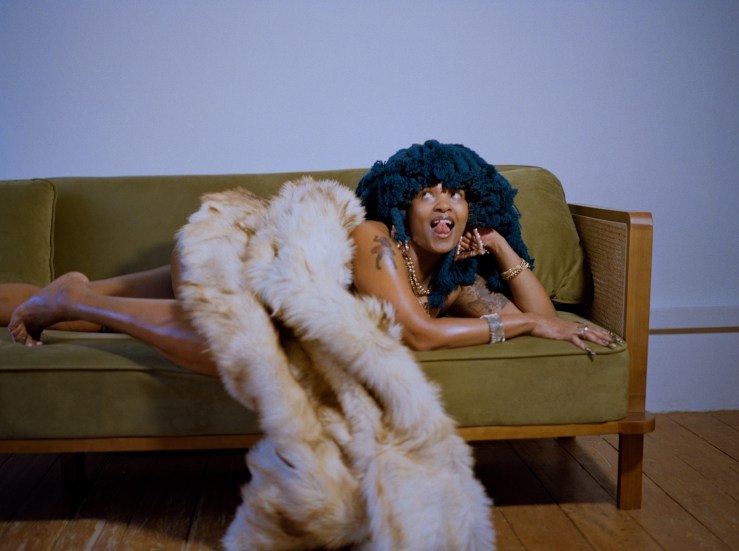
Having released her incredible third album, Full Moon, at the beginning of this year, innovative South African artist Moonchild Sanelly has been making waves with her unique, empowering genre-defying creations and joyous live shows. Now, with collaborations with the likes of Self Esteem, Gorillaz and Little Simz under her belt, as well as wowing UK audiences at Glastonbury Festival and appearances on Later… With Jools Holland last year, she’s ready to take the world by storm with this latest trailblazing solo offering and her immense, fearless attitude.
Ahead of a run of tour dates with Self Esteem in the autumn and an appearance at my most favourite festival, Deer Shed, this summer, I was lucky enough to chat to Moon just as she was getting her costumes together before jetting off to Dublin to headline the Grand Social earlier this week. Her styling and aesthetic are a big part of her performances and image as an artist, she tells me, as she explains that she designs and makes her own outfits – “Having the skill to see it, think it, sketch it, make it, advise on it, has been really useful. Having the power to just create my art… All these things contribute to me being a musician and independent artist.” Moon actually studied fashion before going on to become a songwriter, and she continues to put the skills she learned to use when going out on tour – “I know all the different shows I have coming up, and know all the different coloured costumes I want for the different days, and know all the different stage vibes that I want. It’s going to be a fun one!” And these skills can come in very handy when on the road, too, as she discovered on a recent trip to Germany when her sewing machine broke and one of her outfits was left unfinished – “I literally used safety pins to put it together. I come from doing stuff by hand when I didn’t have the money for the fastest machine, so I had to tap back into that and got my safety pins, and nobody knew – it was a great dress, I killed it! It’s something I do on the regular – I was able to save myself, even though my machine had broken.”
This notion of being able to ‘save herself’ seems incredibly important to Moon; whilst having always been supported in her love of music by her family, and particularly her brother who’s a producer, she prides herself on her independence and the power that comes with not having to rely on anyone else: “When you’re doing you, it’s just really effortless; no one can correct you or incorrect you. There’s no right formula. Not even your mum who fed you formula has a formula for you.” Discussing the sense of freedom that can come with being involved in all parts of the creative process, she tells me that she also likes not having a permanent full band, and decided very early on in her career that she did not want to have to rely on other people: “I didn’t want to depend on someone who wasn’t as hungry as me. I didn’t want them to slow me down.” So, she did it on her own, motivated by the liberation to just create whatever she wants, whenever she wants – “I don’t have to wait for anyone… I can literally just do it.”
Of course, this does not mean that Moon doesn’t value the creative input of other people. An example of someone she loves working with is Johan Hugo, the producer of Full Moon, who she had been determined to work with after being impressed by another of his artists at a festival in Europe that she was playing with Gorillaz. Her manager made contact, and – after discovering that Hugo had already wanted to work with Moon, had many mutual connections, and had previously worked with some of her favourite artists (M.I.A, Santigold) – the wheels were set in motion to work together: “We were meant for each other!”, Moon gushes. This feeling of things being ‘meant to be’ seems to be a key theme of the new album: “Full Moon symbolises a real full circle moment for how I have envisioned my art, and how it should be affecting the world. Everything just seems to have come together.” Working with Hugo, Moon was confident that he’d be able to sync the sound in the way that she wanted, to “connect the music with whatever the story is.” She goes on to describe how he was able to create a safe space for her to work, “away from the hustle and bustle”, so that she was really able to tap out and tune into her vulnerable side – “… it just allowed me to open up, without feeling naked or uncomfortable. I just let whatever emotions were evoked by the music come to life. I wasn’t scared of anything that was happening.” However, whilst Full Moon does offer “an insight into (my) sensitive side”, into the “roots” of Moonchild Sanelly, she is keen to emphasise that it still offers that liberating, empowering and danceable spirit that she has become known for: “I will never let it end in tears, because I will always liberate…”
Discussing the recording process, Moon tells me that there was no specific plan – “I just told stories and it was comfortable and I just let it happen… We didn’t have a manual, we just knew we wanted to make fire.” And I think this really shines through when listening to Full Moon; a real sense of freedom emanates throughout, an openness to being both vulnerable and powerful all at once. This stillness and contentment that Moon felt whilst recording the album differs from her experience with her last two records; recording her 2015 debut Rabulapha!, she was travelling around the world working with different people, whilst 2022’s Phases was recorded during lockdown, “…pretty much on my own, just being sent beats, and I hadn’t met half the people that were producing it.” So, she tells me, “…this one was different because I was with the one producer, making music together, and going with the feelings.”
As well as the fantastic creative partnership she has with Hugo, Moon has enjoyed collaborating with many other artists over the years; with each different relationship unique in the way that they worked together. One of the people she’s worked with most recently is GIHE favourite Self Esteem: “I call my collaboration with Self Esteem like elite energy because it was so effortless. We were just having conversations, and then they were the song.” Going on to talk about their closeness and the cathartic nature of writing certain songs together, Moon elaborates: “We just have things in common – like being independent artists, and dealing with mother fuckers, and so that’s how ‘Big Man’ came to be.” Similarly, ‘Plain Sight’ (from Self Esteem’s recent album, A Complicated Woman) was inspired by negative press that Moon had been receiving that she did not feel able to write about: “So, when I was with Rebecca, I was able to write for her because we were going through the same thing but in different spaces and times, which was super emotional. We talked about all our shit, and then we cried.”
With other artists, however, the process has been very different. Whilst featuring on ‘My Power’ with legends like Beyoncé and Tierra Whack in 2019 merely involved sending over recordings of her music to someone she had not met, with artists like Little Simz “…it was just a really chilled vibe”. Having been something that Moon had always wanted to do, and having met Little Simz through her work with Gorillaz previously, finally getting to properly work together on a track (‘Flood’) was a dream come true. Whoever she’s working with, Moon tells me she has one goal – “… my approach is always to deliver”. She is determined to create her art freely, on her own terms, whether that’s solo or collaborating with others.
This freedom of being able to create is something Moon feels passionately about, not just for herself but for others, and is something that can often be difficult for people living in South Africa. Reflecting on this and the way that things are gradually starting to change, she tells me that “social media’s definitely contributed to young people being able to share and create music without gatekeepers…” Young people being able to have more access to music without being attached to labels and managers enables a sense of freedom that has not always been possible, and this is something that Moon is grateful for: “You upload music, get lots of hits, are able to gig. That’s how it happens, and it’s beautiful to watch.” Although there’s still a long way to go, seeing more artists from South Africa being able to tour internationally, and with more opportunities being open to them, leaves Moon hopeful for the future.
Touring internationally is thankfully something Moon has been able to do, and is going to be doing more of later this year, with appearances booked at various festivals including personal favourite Deer Shed in Yorkshire. She describes how she’s feeling about this with one word: “EXCITED!”. I share this excitement as I tentatively admit that I haven’t had the pleasure of seeing her live before and ask what fans can expect: “I KILL. We’re going to run out of body bags. The Freedom Demon shall be evoked.” You’ve been warned, Deer Shedders – prepare for a truly euphoric and empowering experience in which you’ll “own your body and your existence, and know who you are. You’ll just feel everything.” I can’t wait. Despite being excited about performing, however, Moon isn’t as much of a fan of the “whole hay and squatting thing” at UK festivals and tells me that her one requirement is “a flushing toilet, please and thank you.” I empathise with this sentiment and encourage Moon to book her camping in the lovely glamping of Tangerine Fields at the festival, where there are lovely flushing loos and even showers and hairdryers on offer.
Moon is no stranger to UK festivals, however. Last year, she wowed crowds at Glastonbury with not one, not two, but ten live appearances there – “… it was the most shows we’ve ever done in one weekend”, she beams, “It was gorgeous. It was ridiculous. It was epic.” Not surprisingly, named as one of the highlights of the weekend, it seems like it stands out as a really special and memorable experience for Moon as she cheekily reflects: “We worked our butts off, and we shook them too!”
Being in the position to tour and perform to thousands of people is not something Moon takes for granted as she recognises the challenges that people from marginalised communities face in the industry, and the stigma that can so often be placed on certain groups – “Like, with femme presenting women who are queer, they think sex. And with butch presenting or more masculine people, they can’t be soft.” Discussing this further, Moon reflects on the evolution of Little Naz, how he was “palatable” for the homophobes, “…but then, when he came out, he lost a lot of followers, because you can’t be flamboyant”. This specific stigma surrounding gay men in music is something she has noticed is still not being commercially accepted, but “I feel like we, as women, have got more of an advantage, because we already know the formula of how to get the market.” However, Moon acknowledges that not everyone has her confidence – “I have a lot of famous friends that don’t want to share their sexuality… And this comes from a fear of rejection.” This fear is something that sadly seems to be prevalent amongst queer artists, and is absolutely justified considering the political climate at the moment; the hate speech, the way that the industry “seems open to abusers, to those violating other peoples’ rights, but not to homosexuality…” If we are to move forwards from marginalised communities being more than a “niche” and being more commercially accepted, Moon feels that representation is incredibly important: “With regards to my being queer. With regards to my being a successful black artist. With regards to whatever the world sees me as. I bring that magic. All the different faces that I represent. And I do it proudly and loudly. And fearlessly. Fuck fear.” Whilst others may have seen what Moon has achieved as impossible, she has succeeded and continues to move forwards with passion, determination and joy. “It takes people like us to shine the light”, she clarifies, and shine she does, as a beacon of what can be achieved. If aspiring artists were to be able to see more people like her, to see themselves represented, I feel this could really help to inspire, to motivate, and to reassure; to take away some of that fear that holds us back. I’m sure that when aspiring creatives see Moon being her truly authentic self up on stage, on TV, hear her on the radio, this will empower and ignite that spark in them.
As I thank Moon for her time, and for being such an inspiration and joyous presence in the industry, she assures me that she’s going to continue moving forwards and creating, innovating: “This shit is my life. I don’t want to be confined, I don’t want to be still. Every other job I’ve had, I’ve lost or quit. But now I’m in the right place.”
Huge thanks and love to Moonchild Sanelly for speaking with me. I cannot wait to be taken away in a body bag after the immense experience of seeing her live at Deer Shed festival in July! Tickets still available here.
Mari Lane
@mari_getinherears
Photo Credit: Grace Pickering

 Get In Her Ears