
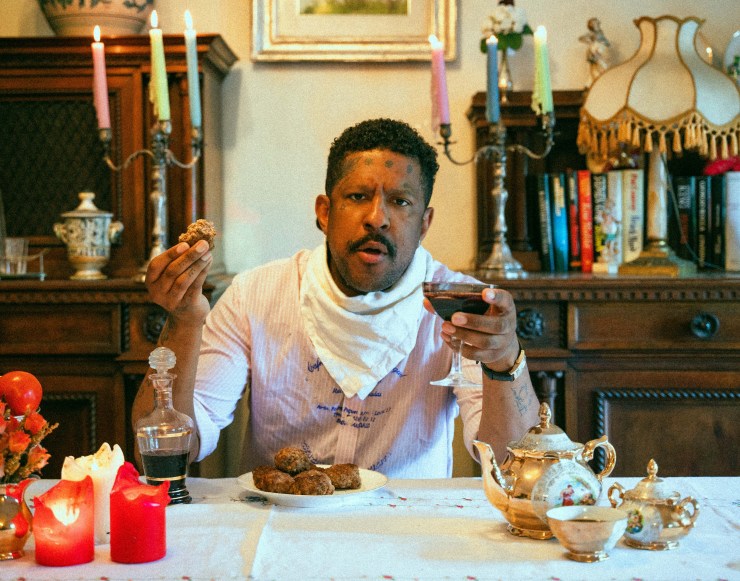
Mykki Blanco really doesn’t need any introduction from us. We’ve been massive fans of the queer pioneer and innovative artist for many years now; they’ve been a huge inspiration to the team and have dazzled us with their live performance more than once. So, we’re super excited that they’ll be releasing a brand new EP later this month.
Postcards From Italia is set for release on 22nd September, and offers an instantly uplifting collection of colourful, danceable anthems. Fusing together influences ranging from Euro dance beats to Country hooks, we can’t get enough of the funk-fuelled energy and effervescent spirit that runs throughout.
Fresh from celebrating Copenhagen Pride, Mykki spoke to our Tash Walker last month about the upcoming EP, how the music industry’s changed over the last decade, their queer inspirations and more. Have a read, and make sure you tune into our next show on Soho Radio on Monday 18th September to hear some of the chat there!
We’re massive fans of you, and it’s an honour to have you speaking to us today! We obviously have quite a few questions for you, but we’d love to focus on your upcoming new record Postcards From Italia, which feels quite different from your previous albums. So, how are you feeling about its release?
So, Postcards From Italia is an EP – it’s only 15 minutes long! But sonically, it really continues the musical journey that started with releasing Broken Hearts & Beauty Sleep in 2021, and then Stay Close To Music, which was a very, very contemplative, very melodic record, in 2022. Most of the songs for Postcards From Italia, even though they’re upbeat, were actually recorded in that same kind of time period as those other two records, so it just really continues a very stark departure into kind of what my music sounds like now, and not what my music has sounded like for roughly the last ten years. I think if a musicologist were to note any markers on my sonic journey, there’d basically be the beginning of my career up until the pandemic, and then the pandemic kind of marks a very stark difference in not only the quality of my music, but just the sonic journey. And I just think that, for me, everything that I’ve come out with since 2020, has, has been like “this is my sound” – this is the music that I make, and less and less of kind of an ever winding journey. I don’t know. I mean, I guess there’’ll always be an element of a journey. But yeah, I think what I’m now creating reflects more how I really feel.
You’ve described this as your “Italian Cowboy Era” – can you explain?
I didn’t say that actually. I think someone from Pitchfork or one of the first music journalists that got the new press release kind of put their own spin on it after listening to some songs, and they said that, and then the record label said that and now people are saying that… Which I guess I’m okay with!
I think the label of “Italian Cowboy Era” maybe came from the lead single ‘Holidays In The Sun’ – the way in which my tone and cadence, and the way in which I delivered the lyrics, is a reference to country music – country music like over Euro dance production… And there are two other songs where I give a similar country western vibe, like ‘Magic On My Back’… Wow, I get it, that’s why they probably said that!
You got it. You reclaim it!
I just reclaimed it. Not joking. I had not thought about that.
You’ve mentioned it already, but ‘Holidays In The Sun’, the current single, is such a tune. I love the ‘90s dance vibe. The first time I heard it, I think in just the first ten seconds my head and my shoulders were moving away – it’s so infectious. And then magical. And ‘Magic On My Back’ was another one – it’s so sexy. It’s got this really sexy groove to it.
Thank you! I just wanted to release something upbeat – something really fun. So, I’m actually about to start grad school. I’m moving to Switzerland to do an MFA in Fine Art, because I want to focus on Environmental Humanities in painting. I’m really interested in ecology, but kind of like post colonial ecology. So, like ecological studies through Africa and Asia and South America, rather than through a Eurocentric lens – like environmental chronology. The programme is almost two years long, so I wanted to put out something fun before I start school, because once I start, I’ll have to have my head down to study!
I also read that you didn’t start writing until you were 25. So, it’s interesting now that you’re going into this other phase of going to grad school and looking into art and ecology. Why is that do you think? Was it a conscious decision to start writing at 25? Or was it just the right moment, just something that you were you were drawn to?
It was really my first manager that pushed me into music. As a child, I lived in two places – I lived in the Bay Area outside of San Francisco, and I also lived in North Carolina. And I was just always naturally very drawn to theatre; I loved performing in front of people, and I also loved creative writing. Then, as a teenager, that manifested into me doing more theatre and I found out about performance art. But then I went to art college – well, I went to two different art colleges and dropped out of both, but still very much thought that the trajectory of my adult life would be centred in the art world. I thought I’d figure out some way of working as a contemporary artist and writer, but I never saw myself as a person who would go on to do journalistic writing. But, about ten years ago, I published a book of poetry, and one of the things I am really invested in doing this year, in grad school, is beginning to actually really write either a novel or (very) short story. But, back to your question! I thought I was very much going to have this trajectory as a contemporary artist in the traditional sense, and it was not until I met someone named Charles Damga, who owned a record label called UNO Records in New York, that I started to think more about writing. Basically, Charlie came to a few of my performances – I was doing these performances at different parties, and I was starting to release things online and, I guess for that time, it felt very original, on the cusp of something that people had not seen before. And I just remember, Charlie and I had this conversation where he said something along the lines of “I feel like you’re making music and you don’t know that you’re making music”, but I was still very much in this art world context about everything. And he asked me if I enjoyed songwriting, and if I’d ever considered working with producers, and I was like “I don’t know what a producer is…” So, he suggested giving it a try and pairing me with someone, and I was like “Sure”, and he linked me up with about four different producers and I started to understand that I can communicate certain ideas and together we could translate the production into a song. I didn’t really know what I was doing, I was just enjoying myself, but then over a couple of years I realised that, though I didn’t know how to produce in a traditional sense, I always know sonically the cornucopia of songs or influences that I want. And it was really this exercise in, not only growing in confidence with myself, but as a songwriter, that helped me understand that I could do it, even though I’m not ‘classically trained’ in composition or anything. It was also the community of producers in the community and other musicians that helped me reocognise that I had a talent for something, even though it was undefined.
Looking back at your career, it’s been amazing! You’ve worked with some really incredible artists, but you’ve also clearly worked really hard to get where you are today, doing lots and lots of touring. How does it feel to you looking back over the years, to where you are today?
One thing I would say is that I’m very fortunate to have come along at the time that I did, because I don’t think I would enjoy the politics of being a brand new artist right now. I feel that with every generation that crops up every five or so years, there’s some select artists who really push the envelope sonically, through their imagery and aesthetics through their message. The universe seems to equip them in ways to persevere beyond whatever challenges the music industry, or society in general, might be placing on them. But I think there are a set of challenges right now for new artists which mean it’s just become harder; I would say it’s become harder for new artist to really make a living and to have a real quality of life. Even though I’ve experienced so much transphobia and homophobia, and had certain media outlets be so rude and inhumane to me at certain parts of my career, I think at that time many paradigms around being queer and being trans were being completely blown open. I was able to explore, or maybe come to terms with, my gender, maybe a path was widening that did not exist before. A true spiritual experience.
I feel that, unless you were a musician during the last ten years involved in a certain kind of underground culture, maybe you wouldn’t understand this… But, from around 2012 to 2020, something happened where, because of the internet – things like Tumblr and Twitter, and the whole nature of social media – it really transformed and changed communities all over the world. People were able to say “Hey, listen to this indie / feminist / punk band / queer rapper”, and people were able to hear their music on the internet and book them. This created a network globally, where historically artists that would have really dwelled in the underground were able to have agency; to actually make money, to actually look forward. And that’s really important, and I don’t hear people talk about that enough. Sadly, with the pandemic, a lot of that has been diminished; and the effects of that are not completely over. There has been such a reduction in independent venues; a reduction in bookers and people who are willing to book independent underground acts. The network globally is still there, in a sense, but it has diminished. I really see now, again, the dominance of pop stars in a way that I saw it ten years ago, because pop stars are always going to be there. But in the last nine years, it seemed like music listeners were getting more invested in indie underground artists. And ok, your pop fans are always going to be your pop fans, but I’m seeing this dominance again of major label artists. And that kind of scares me, because it feels like we’ve gone back in time, and it’s such a shame because it felt like things were starting to really shift for artists at certain tiers that were not a part of the major label system.
This comes back a bit to what you were saying about what you were experiencing within the industry – I remember I think maybe it was around, 2016, I saw the video of your days reciting the Zoe Leonard poem, ‘I Want A Dyke For President’, and it was just so perfect. It felt so powerful and apt to bring those words to life at that period of time. You’re an artist who is always pushing for people to see the world differently, I think. And I think sometimes I also think that when you’re queer, and you’re born into a world where you don’t make sense, you sort of have to break it down and build it back up in a way that you can then insert yourself into it. Which allows us, or some queer people, a chance to see the world so differently, and to think differently. And I’m really glad to have had that experience. But I wanted to ask you, who helped you to see your future when you were growing up?
Yeah, I feel like – even though it’s well intentioned – there is a very neoliberal need to commodify and kind of glamourise queerness. But I get it, because then it becomes or can lead to the celebrated education of queerness. But it sort of is like we’re only seeing the pretty people… When I look on Instagram, and I look on Twitter, I love seeing a trans male activist with 850,000 followers, and I love seeing all the trans women who are gaining accolades and I love it when I’m able to connect with other gender-nonconforming queer people who now have large platforms. But it’s still this thing where a lot of the people that shaped me are what you might consider ‘outlaw’ queer people; people that don’t necessarily live in the big cities, that may have existed through sex work, or through anarchist or more community networks. They are just being naturally gender nonconforming, and so much of society – even mainstream LGBTQ society – might find them unruly, or even unattractive. But it’s these people, my friends from these communities, that I would say have really nurtured the radical ideas that formed the foundation of my true virtues.
When I think about specific people that you might know, there’s Brontez Purnell who I’ve known since I was 18. And I think Alli Logout from Special Interest is someone whose politics are on the money and I feel like whenever I’ve encountered them, they’re always giving me this nice, fresh perspective on something. Then there’s Ericka Hart, who I would consider an activist; she talks a lot about intersectionality, and her partner is trans. They just had a baby and so she talks a lot about this intersection of being black in America, and queerness.
And, finally, I’d like to name one more – Munroe Bergdorf. I’ve known Munroe for a long time and she inspires and interests me. I’ve really followed her journey closely, and she does feel to me like an infiltrator, because she is able to slip into the mainstream, glamorous radar, but she knows her shit and she knows the real deal. No matter how glamorous she is, and no matter how many talk shows she goes on, I never hear her giving a palatable answer just for the sake of making the mainstream feel comfortable or better about themselves.
Yeah, I met her about 10 years ago when she DJ-ed for this charity and LGBT helpline charity that I volunteer for, and it was just before she started to, like jump onto the platform that she’s on now. It’s been amazing to watch her, and she’s never faltered in her her views or her purpose – she is she knows who she is, and she knows what she’s going for.
Okay, I’m conscious that I don’t want to keep you for longer than you have to! So, lastly, I see you’ve hit up a couple of dates across a number of European festivals over the last couple of months, and we’ve all seen you a bunch of times in London, at Southbank Centre and Village Underground when you played there, which was outstanding! We were left absolutely buzzing, like properly fizzing under our skin! So, has there been a particular event you’ve played that’s stood out to you over the years?
It’s so difficult to answer this question because it’s been almost 11 years of so many different kinds of gigs… But I would say that, honestly, I can be in any room; it doesn’t have to be 1000 people, it could be just 400 or 500 people who are really engaged and watching me, singing the words back. I’ve had that big festival experience, and maybe one or twice in my career when that huge big room didn’t feel any less powerful than a smaller one. But when 400 or 500 people are just completely engaged in what you’re doing – sweating and pouring our hearts out into each other – it feels very special. I like to create a moment sonically and aesthetically, and when it all comes together cohesively, and people are engaged with what I’m doing, that feels good. Because I’ve been doing this long enough to know – I mean what is a career, but a string of continuous moments?
Totally. I feel like that about archiving as well. The lack of archives there have been past a certain point, and censorship and all of that sort of stuff. And so, you doing these things on an ongoing basis as an artist is so important.
Thanks so much for taking the time to chat with me, Mykki. And, best of luck with the record!
Okay, thank you so much for having me. And big love to all of you out there!
Hugest thanks to Mykki for taking the time to chat to us! Their upcoming new EP, Postcards From Italia, is out 22nd September via Transgressive.
Photo Credit: Cecilia Chiaramonte
 Get In Her Ears