
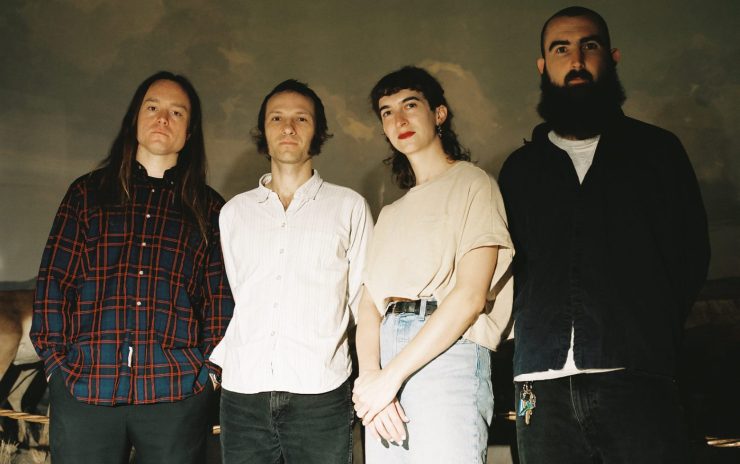
Bassist and vocalist Leah Levinson from Los Angeles black-metal noise merchants Agriculture is a potent voice in the heavy music scene. Sharing songwriting and vocal duties with guitarist Dan Meyer, Leah’s guttural screams permeate the band’s diverse, doom-laden sounds; now coined as “ecstatic black metal”. It’s not just the physical volume and sheer power of her voice that has garnered Agriculture such a loyal following though. On the band’s most recent album, The Spiritual Sound, Leah’s raw lyricism tackles transphobia, queerphobia and misogyny; highlighting how vital her voice as a trans woman truly is.
Released via The Flenser in October this year, The Spiritual Sound is a culmination of both Leah and Dan’s dismantling of the human experience, in both its most simplistic and most complex forms. Take the deeper, more personal cut ‘The Weight’ for example, on which Leah explores both the triumphs and the traumas of queer life.
“‘The Weight’ was written reflecting on a particular month last year when so much seemed heightened,” Leah explains. “It seemed like many of my friends were being harassed in public – both verbally and physically – for being trans, for being queer and/or for being women (it’s not always clear which). This was also a time when I was feeling a lot of love and a lot of community. I wanted this song and the songs around it to honestly reflect both these elements. I wanted to write about transness, but didn’t want to rely on political aphorisms and indulgent images of suffering. I wanted to paint a holistic portrait of queer life.”
We think one of the best ways to get to know an artist is by asking what music inspired them to write in the first place. We caught up with Leah to ask about her “Five Favourites” and she picked five albums by an eclectic range of artists who have inspired her songwriting techniques. Check out her choices below and scroll down to watch the official lyric video for Agriculture’s single ‘The Weight’ too…
1. Lou Reed – Transformer
I don’t shut up about this album. I discovered it when I was about thirteen and have regularly rediscovered it throughout my life since. The songs here are odd, lopsided, messy, and sometimes overly simple. I think they reflect Lou finding himself as a solo artist and coming to understand (alongside the society and culture around him) many aspects of himself, from gender and sexuality to drug use and spirituality. It’s an album about being in the world that sounds like it comes from the pitch black of nowhere. The production and arrangements by David Bowie and Mick Ronson hardly nod to rock music; letting chamber, jazz, and symphonic instrumentation flirt alongside Lou’s gravelly voice while more traditional rock instruments are mainly used in less conventional ways. I sometimes think of these songs as nursery rhymes and lullabies for addicts and queers, and, in that way, so many lyrics from this album exist in my mind as riddles, koans, and mantras that I’m sure I’ll never solve. This album has shaped my life and output as an artist in immeasurable ways.
2. Laurel Halo – Quarantine
This album came out when I was at the formative age of eighteen and hasn’t left me in the decade-plus since. I think it has one of the greatest covers of all time and somehow manages to live up to it. As a collection of deconstructed ambient pop songs, I find this album difficult to ever really grasp. At the same time, that ungraspable, atmospheric quality feels at odds with its earworms and its moment-to-moment intrigue. It’s a beautiful instance of an album that feels like an entire world, perfectly paced and thoroughly explored. Any time I hear it I feel I am home without ever really knowing (or having to know) what it’s about in the first place.
3. The Velvet Underground – The Velvet Underground & Nico
I have a hard time choosing a favourite between The Velvet Underground’s first three albums, so I’m going with this one because it was my introduction to them and in many ways, it feels like it’s got it all in one. The repetitive, minimal song structures on this album influenced me at a pretty young age; an early lesson that less can be more. Moe Tucker’s drumming is an important contributing factor for that, and I think deserves greater acknowledgement as a major innovation in rock, pop, and underground music. Beyond that, the arrangements on this album showed me both how little you need to make something work, and how much noise and complexity a listener can tolerate when there’s a strong song at the center of it. I’ve also always loved that the album has multiple voices on it, with Lou Reed and Nico alternating leads. That’s something Agriculture has and something I try to do in some way on most albums I make. I think it makes an album more vibrant and less lonely and monolithic. This album laid the format for so much music I love that comes after it, from the Ramones to My Bloody Valentine to Godflesh and others. It’s the foundation.
4. Entombed – Left Hand Path
This is my obligatory metal choice for this list. It’s unlike any other metal album I’ve ever heard, but in such a subtle way. Entombed formed in 1987 from members of Nihilist and helped establish the early Swedish death metal scene. This album is sort of the ultimate demo of the drop tuning and “Swedish chainsaw” sound of the maxed out HM-2 pedal that together came to define the Swedish death metal sound. To me, that sound is heavy in a warm way. Feelings of both dread and comfort coexist on this album, like there’s this push and pull around a fear of death and a complete acceptance of mortality and fate. I think this is emphasized by the material on the album which feels much more serious and mature than the slasher, sword and sorcery, vampire, and simplistic satanist imagery that permeated metal at that time. This is one of the few metal albums that feels like it’s about death in a real way. That its guitar solos, demon growls, and headbanger riffs don’t detract from that, but rather add to it, makes it all the more special.
5. Albert Ayler – Love Cry
The Albert Ayler Trio’s Spiritual Unity was one of the first and furthest out pieces of experimental/avant garde music I was introduced to. The song ‘Ghosts’ was kind of an anthem for Ayler – there’s two versions on that album alone and he continued to revisit throughout his career – and it’s the song that drew me to Ayler for years and years to come, while I puzzled over the cacophony that surrounded it. Ayler’s project is one centered around collective improvisation and the asynchronous comingling of spirits through music. What makes ‘Ghosts’ so great is its tuneful, almost naïve melody that is defiantly bright and strong. It provides coloration and structure to the unbound playing that delivers it while giving a strong footing for its improvisers to take off from. That song is revisited early on Love Cry, an album that adapts Ayler’s early vision and imagines a way forward with it. Love Cry has some of the most innovative arrangements in jazz for its time in a way that still sounds fresh today. Beyond that, it expands on the compositional conceit of ‘Ghosts’ in its many songs without ever repeating itself. It’s an album that shows Ayler searching spiritually in every direction and finding answers only transmissible through music.
Thanks to Leah for sharing her favourites with us!
Watch the lyric video for Agriculture’s single ‘The Weight’ below.
Follow Agriculture via bandcamp, bluesky, Facebook & Instagram
Check out Agriculture’s official website too
Photo Credit: Olivia Crumm

 Get In Her Ears