
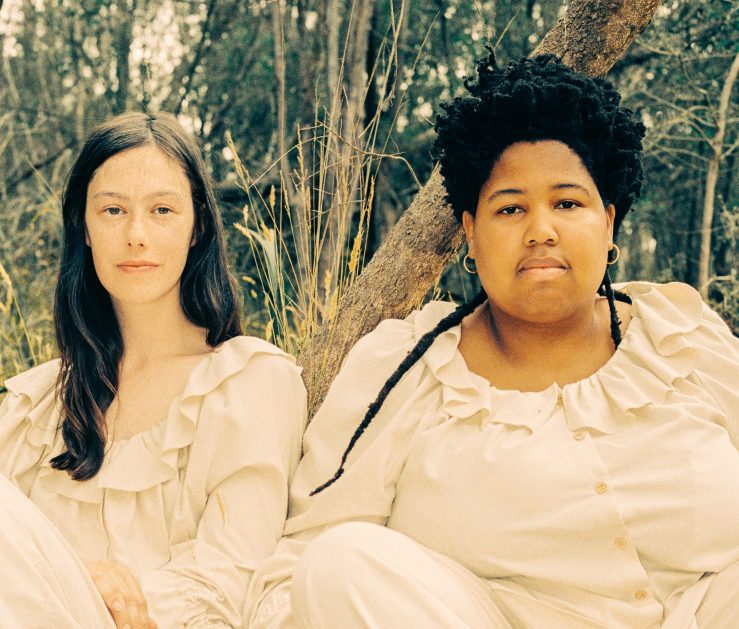
Fuelled by Takiaya Reed’s doom-ridden saxophone sounds and Sylvie Nehill’s phenomenal percussion, Divide and Dissolve create idiosyncratic instrumentals designed to erode the foundations of colonialism and liberate the land for indigenous communities. Flowing with a unique gargantuan grace, their second album Gas Lit has been haunting our ears since it was released in January of this year. We caught up with Takiaya to talk about the record, the reception that it’s had, the new Remix EP that it’s inspired, and a shared love for Radio 6 presenter Mary Anne Hobbs…
Hello Takiaya, how are you doing today?
I’m good, I’m in finals right now, so I’m studying a lot and trying to drink enough water to feed my brain. I’m studying psychology. It’s intense, but I feel super chill about it, because it’s all just a pseudo science. It’s kind of comical trying to find ways to talk about things that are extremely inaccessible and continuing to perpetuate all these things that are sometimes helpful, and sometimes not. The mind is so mysterious and vast, and we’ll never really know what it’s capable of…
I think you should put that in your final essay. You should just end it with that sentiment.
Yeah, they’ll be like “50 Points off for not using enough empirical evidence…”
That’s true, maybe don’t listen to me…
Musically, let’s start from the beginning. Can you remember who, or what first inspired you to start making music? And how Divide & Dissolve first came together too?
It was my dad who first inspired me. I started out playing piano but then he was like, “hey, you look like a saxophone player,” and I was like, “what? A sax player, really? I thought I should play trombone or something?” but he said “I know you’re a sax player. I play trumpet, so we could play duets” So he got me started on playing saxophone and I felt this intuitive almost spiritual connection with the instrument. I still roll my eyes at my dad for what he said about looking like a sax player, but I think there’s something to him having had that knowledge.
Then later on, I was inspired to play guitar because I met my friend Osa Atoe, who does Shotgun Seamstress and was in a band called New Bloods. She showed me how to put on shows, how to set up a PA and she told me to play guitar. Osa was super inspirational in terms of me not playing classical music, which is what my first passion was.
With Divide and Dissolve, I just had a good friend say to me “Hey, you should meet Sylvie, you two are going to love each other” and we instantly just got along. It’s not a very eventful story, it’s just more like, “hey, you’re cool. Okay, cool. Let’s play music. Sweet!” We’re both super chill people, so it just works. I’m trying to trust in that. When making decisions about life, sometimes it just feels super right, like you’re just supposed to be there. Those are probably very good guiding principles.
It sounds like you rely a lot on your intuition, which surely can only lead you to the right kind of people and the right kind of things.
The music you make as Divide and Dissolve, is fuelled by a powerful anti-racist, anti-white supremacy, anti-colonialist message. Do you feel like your music is uniting and educating people about these issues?
I can only hope that it is. It feels amazing to be able to talk about the things that we want to talk about, and be able to experience relationality with our ancestors, our relatives and our kin, and to be able to talk about the Earth in this way and just feel all the resonance. That’s just what we’re about in general. So I feel super grateful and I don’t want to take any of that for granted. I want to be able to continue to connect with people in these really positive and meaningful ways. That’s just how Sylvie and I are.
We’re pretty focused and we want to directly communicate our message. We would like the systems that continue to perpetuate genocide to end. If you can imagine something ending, then it can end. Instead of living in the world where you feel like, “oh well, that’s not possible” – you should try to believe that anything’s possible. That’s where I’m at.
That’s a really refreshing and hopeful sentiment. You do a magnificent job of making listeners feel this way on your most recent album, Gas Lit. What would you say you were most proud of about this record?
I remember having a conversation with Ruban Nielson (Unknown Mortal Orchestra) who produced the record, and I just told him, “I hope people can understand exactly what this album is about.” We put a lot of intention into the album when we were writing it. We put a lot of effort and love in, and we consulted with our ancestors. So when it was released, the way people were writing about it and talking about it felt so attuned. They knew what the album was about without me even specifically telling them what it was about. It was abundantly clear and that still feels incredibly special. It’s so amazing to want to communicate something, and then to have it actually happen. It makes me feel super inspired to continue playing music. I love that Sylvie and I get to do that with one another. It feels like such a blessing.
Do you have a favourite track on the album? Is there one that you enjoyed recording the most or one that you enjoy playing live the most?
Do you know what, I don’t feel properly equipped to answer that question yet, because we have been in a pandemic and this music hasn’t been played live. But, I feel like I’ll know the answer once we go on tour. I’ll be like, “Oh my God, it’s this song!”
The creation of all of the songs was so unique, so it will feel awesome to learn more about the album in terms of performance when we play it live. It feels so wild to be able to do such a thing, because we haven’t had the opportunity to. I’m very excited to play live. I feel optimistic and hopeful that live music will return in a way that feels meaningful and good.
I can’t wait to catch you live when you’re here in the UK. You’ve recently released a Gas Lit Remix EP, featuring tracks by Moor Mother (‘Mental Gymnastics’) and Chelsea Wolfe (‘Far From Ideal’). Talk to me about how this EP came to life…
Our label, Invada, thought it would be cool to do some remixes and I just knew who I should hit up. I feel so connected to both of Camae (Moor Mother) and Chelsea. I think they are both amazing people who do amazing things. It feels so special that they would want to work with us. It just makes me smile a lot.
I’ve just seen that BEARCAT has also remixed a track for you, which is cool!
The visuals that you’ve shared to accompany the Chelsea Wolfe remix and the Moor Mother remix – shot by artist, writer, and filmmaker Sophia Al-Maria who currently has a sculpture at the Serpentine in Hyde Park – compliment the songs so well.
I love music videos. I don’t know how to make them myself, but the visual world is so interesting. I love it when people who have an understanding of it decide to connect with us and tell another story. Maybe they make it deeper, maybe they don’t. It feels special to try and achieve deeper communication. I think it enhances the music and I love that. Anything that helps us to be able to feel this feeling deeper is awesome. But also, maybe the videos help you not feel things as deeply, and that’s awesome as well, because maybe that’s what someone needs.
I agree, I think there’s a nice balance between the visuals and the sounds.
We’re big fans of Divide and Dissolve her at GIHE, and someone else who also is also a big fan of yours is Radio 6 presenter Mary Anne Hobbs. How do you feel about that?
I really want to meet her, she seems so cool. Sylvie and I want to hang out and eat food with her. She’s across so much cool music, she has really great energy and it feels like such a huge blessing to have her understanding of what we’re doing. I admire her, I think she’s awesome.
We think she’s amazing too. Maybe this will be the interview that she reads and then she invites you to dinner?
Finally, what else is on the horizon for Divide and Dissolve?
We’re going on tour soon and we’re playing Roadburn in 2022, so that will be fun!
Thanks to Takiaya for speaking with us.
Order your copy of the Gas Lit Remix EP here
Follow Divide and Dissolve on bandcamp, Instagram, Spotify, Twitter & Facebook
Photo Credit: Jaimie Wdziekonski
Kate Crudgington
@KCBobCut

 Get In Her Ears