Re-Covered: Sally-Anne’s Illustrated Favourite Albums

If you’re anything like us, throughout Lockdown you may have been seeking refuge in some of your favourite records, perhaps rediscovering some old classics along the way. So, for this new feature, illustrator Sally-Anne Hickman re-imagines her favourite ten albums of all time by painting their covers in her own unique style, using watercolours.

Check out the eighth of Sally-Anne’s choices below, and keep your eyes peeled for the last two over the next couple of weeks…
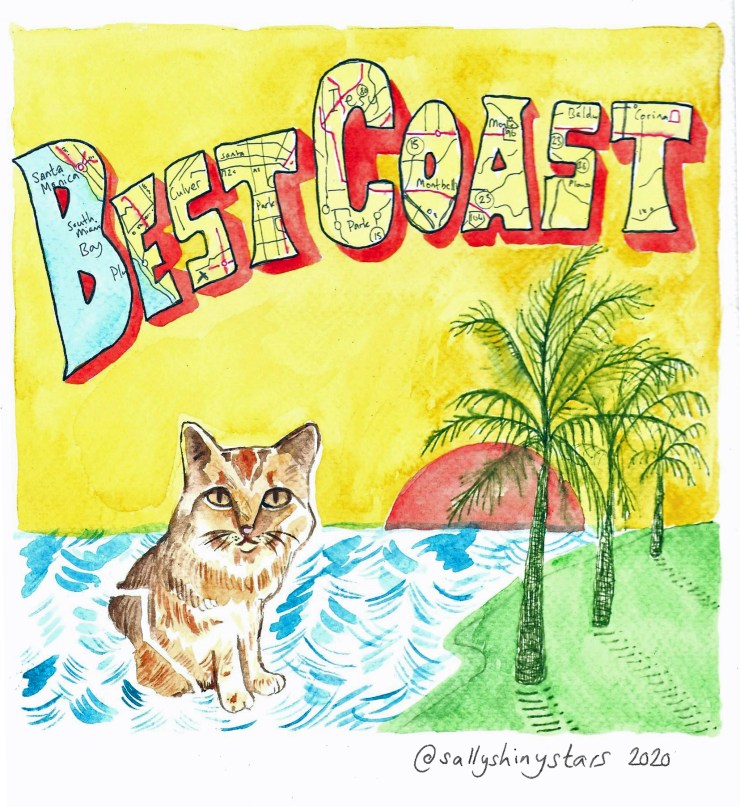
Best Coast – Crazy for You
This L.A indie rock band are a blend of classic surf-rock and 1960s girl-groups. Fronted by singer-songwriter and guitarist Bethany Cosentino, each fuzzy pop song comes in at under three minutes. It’s simple catchy pop, with perfect melodies layered with reverb and distortion. Songs about longing for a boyfriend and wishing her cat could talk make this a perfect lo-fi, lovesick summer album that you can listen to all year round.

Sally-Anne Hickman
@sallyshinystars

Introducing Interview: St. Blue

Following the release of her latest single ‘I’m Not Your Baby’, St. Blue has proven that making the leap from cover artist to singer-songwriter in her own right was a risk worth taking. We caught up with the South London based singer to find out more.

Hi St Blue, welcome to Get In Her Ears! Can you tell us a bit about your sound?
Thank you for having me. The sound I set out to achieve for this first collection of songs was dreamlike and uplifting. I grew up listening to indie and ’80s music, so I’ve always loved finding hooks outside of the vocal melody, with the guitar and bass lines having just as much of a catchy input. 

When did you decide to pursue a career in music?
I’ve been in and out of music for about fifteen years. It was always something that I kept going back to but more as an escape from whatever else was going on in my life. In terms of putting original music out there, I guess I never really had the confidence to think about it seriously until two years ago. The records I have today are created by piecing together years of song writing material – it felt like the right time.

Your new single ‘I’m Not Your Baby’ is out now – can you tell us what it’s all about?
‘I’m Not Your Baby’ is about a girl I was dating after a major relationship ended. There was so much about the two of us together that we knew would never work but I think that’s why it was right at the time. I wanted to get across that sometimes we are able to act out of habit rather than feeling.

Who would you say are your main musical influences?
So many artists have inspired my music, whether directly or indirectly. I’d say my older influences include Dusty Springfield and Dionne Warwick. More recent artists include Banks, Lykke Li and Jessie Ware.

How is your local music scene? Which venues did you enjoy going to before lockdown?
The North/East London music scene is great! Favourite venues have got to be The Old Queen’s Head, The Victoria, Oslo, EartH and The Roundhouse.

As we’re a new music focused site, are there any new/upcoming bands or artists you’d recommend to us?
My favourite finds of 2020 are The Big Moon, an indie band called Palace, and Arlo Parks is an absolute inspiration.

How do you feel the music industry is for new artists at the moment?
I think it can be really tricky for new artists at the moment, especially as audiences have become more focussed on social media rather than live experiences. I think it can be harder for people with more of an old soul approach as well; this notion that they may not be heard if they’re not promoting online. I’ve learnt so many things since I first released music in November. I think it’s important for us to focus more on our art and not necessarily the amount of attention it’s getting. Your audience will follow in time if you are true to yourself.

Despite the lockdown, what are you hoping to have achieved by the end of 2020?
I’ve been writing brand new material and I’m planning on releasing an EP by the end of 2020. The sound will be more of a relaxed, off beat vibe and more vocally lead. I’ll still be adding some catchy bass lines and guitar parts, as I will be concentrating on a sound that is more organic and live. I have an amazing relationship with my producer and he manages to capture exactly what it is I’m going for.

Huge thanks to St. Blue for answering our questions!


‘I’m Not Your Baby’ is out now.

INTERVIEW: A.A. Williams

Due to an admin error, I’m running twenty minutes late when I get through to A. A. Williams to chat about her new album, Forever Blue, on Skype. I apologise and self-flagellate saying I hate to keep people waiting, but she’s genuinely not bothered by the tardiness but much like me, she also can’t deal with being late herself. I feel instantly at ease.

“Is it alright to do this off camera?” she asks. “I did an online interview the other day where I spent about 15 minutes watching this lovely Dutch man waiting for me to un-mute my microphone, because I couldn’t do it for love nor money at the time. I just watched his face for 15 minutes thinking ‘this guy must hate me'”. It’s reassuring to hear someone else is fatigued by the “new normal” of interviewing via video conferencing software. “I’d rather just go for a cup of tea to be honest.” I nod enthusiastically even though she can’t see me. I laugh and say I feel like a budgie pecking at its own reflection in a toy mirror when I’m sat on a video call, so I’m happy to chat off camera.

For those who don’t know, A. A. Williams is a classically trained, multi-talented musician whose blending of post-rock and post-classical elements makes for exquisitely raw listening. She released her self-titled EP in 2019 via Holy Roar and is set to release her debut album, Forever Blue via Bella Union on 3rd July. Before the UK went in to lockdown in March, she gave her debut performance at Southbank Centre’s Purcell Room. “We were like Indiana Jones sliding under the door coming down, we only just got that gig done” she jokes. “It felt like an unwritten cut off point. It seemed to be a lot of people’s last show and I’m glad I got that in before it all went a bit wrong.”

Williams recalls feeling “nervous as hell” on the night, despite the show nearly selling out. “I’m not that great at remembering gigs to be honest, I remember going on stage and going off stage. The stuff that happens in the middle is a slightly out of body situation. But having the cellists with me for the whole show was beautiful. It was a dream come true, if I could do that for every gig, I would.”

We talk about how a venue like Southbank Centre is built for classical music and a perfect way to experience her sublimely dark sounds. “It’s a bit of a luxury to play somewhere like that to be honest. People spend millions of pounds acoustically designing these rooms, so they’re fabulous. They’re a joy to watch music in to. You can take your drink, sit down, relax. It’s a nice change from squished sweaty venues. A little bit of the high life.”

Unfortunately, for both musicians and their fans this “high life” has been abruptly put on hold due to the current pandemic. Southbank Centre’s doors are shut, as are the squished smaller venues across the UK during lockdown. To keep herself busy during this gig-less period, Williams has worked on her “Songs From Isolation” series. She shared monochrome videos of her covering tracks by Radiohead, Deftones, Nick Cave, and Nine Inch Nails.

“I put up a message on my Instagram saying I would like to do some piano-based songs to try and use my time and be productive” she explains. “I thought people would be like ‘Hey, can you play ‘Belong’?’ but instead they were like ‘Hey, can you play Nick Cave?’ It wasn’t what I had planned, but it was actually a really nice surprise. Lots of people suggested the same artists, so it was a nice challenge to try and choose a song that would be right for my voice, and that I felt I could do some justice to. I didn’t want to choose something super obscure.”

I ask about her process for deconstructing each song and wedge in that my personal favourite is her cover of Nine Inch Nails’ ‘Everyday Is Exactly The Same’, which she says took her the longest to work out. “First, I’ll figure out the chords, lyrics, and structure on the original. Then I figure out if I need to change the key to accommodate my voice, which I didn’t need to do on NIN, which was great! I listen out for any motifs rhythmically or melodically. With these covers, I didn’t want to risk it ending up like karaoke. I was trying to keep as far enough away from the original so that we wouldn’t end up in that place. Sometimes it’s easy, sometimes it takes forever, but I think it’s worth it either way.”

I ask if Trent Reznor reached out to her after she shared the cover, even though he maintains a relatively elusive presence online (and is obviously incredibly busy). “No, but I wish he had! I mean, there’s only so many times you can tweet ‘@trentreznor here’s my cover’, you know? I like to think that maybe he stumbled across it. I figured if he hated it, maybe he’d have got in touch? So it’s good that he didn’t I suppose.”

Williams’ appreciation of Reznor’s silence interests me. It suggests a natural patience and intuition for things. Her music is a beautiful balance between loud and quiet, heavy and soft, captivating and alarming. Her sensitivity to volume is what makes the drop-ins on tracks like ‘Melt’ feel so powerful. She recorded most of Forever Blue from her home studio in her North London flat, something which again requires patience and intuition.

“What’s nice is that you can do it any time you want. During the summertime I wake up early because the sun comes into the flat, and I pop in to the other room and start noodling away on demos at 5am, much to the disdain of my neighbours. I’ll record it – albeit not very well – and use that as a base to start to layer a few things in and get some ideas for some secondary melodic parts. In the process of doing that, I end up recording things that often end up being on the album. So, even though they’re part of the demo process, through the process of exploring what works for a song, some of those demo parts end up staying, which is nice.”

This freedom extends into Williams’ recording of vocals too. “I find recording vocals probably the most high pressure. Sometimes, if you’re recording them in a studio and you’ve got lots of people around you, and you’ve got to get however many songs recorded in a day, it’s nicer to be able to take your time at home. I can take as long over that as I want. Having said that, I do live with the bleed of delivery drivers, motorbikes, screaming kids and all sorts of other average London sounds. There’s a hospital just down my street, so there’s probably an ambulance recorded somewhere on the album, along with my dog who has a habit of barking during vocal takes. Have you ever heard a dog bark down your headphones? Oh my god, it is painful. It’s so loud with all the delay and the reverb – if he heard it he’d probably think it was the best thing ever.”

I can’t resist asking what kind of dog she owns.

“He’s a long-haired dachshund. He’s just had his hair cut, he’s very happy with himself. He’s the only person I know in lockdown who’s managed to get a haircut.” As a fellow dachshund owner, it takes all my will power not to turn the interview into an extended piece on why dachshunds are the greatest dogs in the world.

“But yeah, there’s a lot of pros about working from home, but the negatives are always going to be that you’re going to have sound bleeding and you’ll have to spend more time on eliminating that.”

I ask Williams if she has a favourite track on Forever Blue. “That’s hard! That’s not fair, that’s like asking which is your favourite child” she laughs. “I’m not sure. I think in a way, one of my favourites is ‘I’m Fine’ which is the last song. I don’t really know why, it found this accidental place at the end of the album. You land in a hopeful place, it’s not all doom and gloom. It’s a small simple song, but I find songs like that quite cathartic to listen to.

Having said that, I find songs like ‘Love and Pain’ and ‘Melt’ very enjoyable to listen to, partly because I associate them as songs to perform live. The joy of just making lots of noise, let’s be honest, is just great. There is something very cathartic about sticking all the pedals on and making a racket, it’s a very therapeutic experience. I love playing ‘Melt’ live. When we were playing earlier in the year, we’d play it in the middle of the set, and finish with ‘Control’ because I figured if the crowd were going to know any of my songs, it’d probably be that one. But now because of the album, I have the excuse to finish with ‘Melt’ and have all the crazy drums at the end. I’m very excited about eventually being able to get out and play it again. Show it off a bit.”

I ask Williams to reflect on a sentiment she expressed in an interview with Metal Hammer in 2019. She’s quoted as saying “you have to take risks if you want people to take it seriously and be interested” when talking about her EP. I ask about what “risks” she took on Forever Blue.

“There are always going to be people who are doubtful of their output, and people who are going to be confident, and I am the typically doubtful kind. This stuff being out in the world is kind of a risk, to a point. I can’t imagine anyone would make an album and not care if anyone liked it. They want people to embrace it and find a place for it in their own listening.

Including guest vocalists on this album has been an element of risk I suppose. I want people to think it’s an added texture that I couldn’t provide myself.” Forever Blue features guest vocals from Johannes Persson (Cult Of Luna) on ‘Fearless’, Fredrik Kihlberg (Cult Of Luna) on ‘Glimmer’ and Tom Fleming (ex-Wild Beasts) on ‘Dirt’. “As long as you just trust your gut, hopefully that will pay off. I think that’s the only way to do it” Williams explains. “Otherwise I’d never do anything. I’d be worried too much, and I’d just stay at home, staring out the window, being scared of things.”

This fearlessness is something that extends in to Williams’ music and lyricism. Her ambiguous words and fluctuating volume levels are what make Forever Blue such a captivating listen. “Let’s be honest, sometimes volume is great, but you do need a break”, she explains. “In terms of the lyrics, I think my base level of misery is lower than your average person, so I don’t look at those lyrics and go ‘wow, that person’s miserable’, but I can see how some people might. I think everyone’s on a scale with this stuff, but ultimately, it’s just the human condition. Finding someone who’s permanently happy – apart from my dog – is not possible.

People will read into the lyrics in different ways, and that’s what I want them to do. I remember when I first played my Mum my EP, she said, ‘are you worried about coming across as vulnerable?’ and I wasn’t really. I don’t mind being open and honest. These songs are how I feel, and that’s fine. I can’t write from someone else’s perspective. Hopefully people can kind of make it their own a little bit. It becomes a little bit more personal.”

Another interesting fact about Williams in the Metal Hammer interview is that she found a guitar on the street one day with a note saying, “please take me, just needs work”. After a friend performed guitar surgery on the abandoned squire telecaster, Williams – who’s originally a trained cellist – began teaching herself to play it by “mucking around” writing songs. I ask if she has any advice for any musicians who are thinking of learning a new instrument, or anyone who’s learning to play for the first time.

“Even if you’re starting something completely from scratch, it’s so worth it. It’s easy to be frustrated if it doesn’t sound incredible immediately. The amount of times I’ve picked up something and gone ‘I’m gonna learn to do this! Oh look, I’m awful, goodbye…’ Learning instruments takes years, and years and years, but some instruments are much more approachable than others. Guitar, piano, even if you buy a new Mac laptop, it comes with garage band. You can immediately start making little loops and beats, you don’t have to have a clue what’s going on. It’s all there. Just start mucking around with it, just to get your head around the basic elements of what makes a song. You don’t have to be a whizz instrumentalist. You’re not going to get good at it over night, but if you’re doing it for you, that’s cool. If you want to write songs and you’ve got something to say, just do it. Who cares if the chords sound a bit weird? It’s just practice and becoming confident, and thinking that it matters to you.”

Williams’ passion for artistic expression extends beyond music too. “All art is worth it. Whether you doodle, write poems, make little videos – whatever it is – it doesn’t matter. It’s so important to try to give yourself time to do this. Even if it’s just for fun, and you don’t plan on ever showing it to anyone. It’s a really great experience to just sit down, just you and your brain and a piece of art that you’re making. I have no idea what I’d do if I wasn’t a musician. I’m so glad that I operate in an artistic field. I don’t know what I’d do without it.”

I ask Williams what music (aside from her own) she’s been listening to during the lockdown period. She listens to Perturbator when trying to motivate herself to “get on with things”, but her enthusiasm for Run The Jewels’ new album RTJ4 is palpable. “I’ve been known to rap along to Run The Jewels on the bus, out loud, on my own. I think RTJ2 is my favourite album of theirs, but with RTJ4 I feel engaged and emotional about what they’re saying. It’s weird when music hits you that hard sometimes when you’re not expecting it. I have to say, on the first listen, I had a little cry. It’s so powerful.”

RTJ4 was released shortly after the murder of George Floyd, a black man in Minneapolis, Minnesota, who died after a white police officer used excessive force to restrain him during an arrest. The footage of the officer’s knee on Floyd’s neck as he repeated the line “I can’t breathe” sparked worldwide protests by Black Lives Matter activists and their allies, calling for an end to police brutality against black people.

“It’s amazing the number of tweets I’ve seen about the song ‘Walking In The Snow’ which has the line ‘I can’t breathe’ in” says Williams. “People were asking if they’d recently gone back in to the studio to record this track because of what happened to George Floyd, and the band were like ‘No, this was recorded in November 2019’, so the fact that this is still happening is insane. The track with Mavis Staples on is also absolutely beautiful.”

2020 has certainly been a tumultuous and frightening year so far, but it seems that Williams is engaged with everything that’s happening, and grateful to have music as her outlet. Forever Blue feels like a state of mind right now, and her careful treatment of the noisy and the quiet on her debut album is ultimately a soothing experience.

I guess it also helps that she has a cute dachshund to distract her too, something which I bring up again. “He has his own Instagram. It’s @geezerthepup. He’s named after Geezer Butler from Black Sabbath, obviously. You can find him on there being cute and fabulous. I don’t do his Instagram, my husband does it. It’s just a bit of fun.” That’s certainly something we could all do with a bit more of these days.

You can pre-order A. A. Williams’ album Forever Blue here.

Interview: Zebede

South London five piece Zebede were set to take 2020 by storm, but obviously Covid 19 had other plans… However, despite the difficulties of navigating lockdown, they’ve just released their new single ‘Love Me Enough’.

We caught up with lead singer Leah Cleaver to discuss music’s role in the Black Lives Matter movement and what changes we all need to see in the music industry. 

Hi Leah, welcome to Get In Her Ears! Starting from the very beginning, how did the band come together? Did you all know each other from before?
Before I moved to London I was in one of those really tacky uni bands and we all decided to meet up at a party in Fulham. I started talking to a guy called Henry and we became very good friends – we ended up basically getting into bands with each other. He was a drummer and we were doing soul covers and writing a little bit. We had booked this one gig in AlleyCat, which was one of the last good venues left in Denmark Street. It was our first gig in London, and the biggest deal ever. Henry tells us that he has just broken his arm, so I told him that he’s out the band! I was so savage! I already had a replacement as I had been playing in university as part of group work, and so I got in a drummer called Max. He was in the band for a little while. About a year later, Henry got back to me and told me that he had started playing on keys, so the three of us just started writing songs and hanging out for hours and hours. We also needed bass and guitar. In fact, I could have just had bass – you need bass! I enlisted Mike Jones which is just the best name for a bassist. He was so quiet but then he would play and it would be enormous. I had also been watching a guy called Charlie play in class who was just so good. I knew I had to poach him. 

Zebede’s music is a very gentle blend of so many genres, so do you all bring different influences to the song writing table?
100 per cent, we all write the songs together. Sometimes I’ll write a melody and bring it to the boys, or one of the guys will have the chords. To be honest, 80 to 90 per cent of the time we’re all in a room and we all chip in with everything. I love Soul, Motown, Blues, R&B and Funk. Charlie is a massive jazzer – he loves Jazz. Mike is a Motown King, and Max is completely ’90s Hip-Hop. Max is my ‘go-to’ guy; I don’t know what it is about drummers but they’re always the coolest people in the band. Henry doesn’t really have a set genre, but as a pianist he writes very beautiful melodies. We never try to go for a certain genre, it just comes out as it comes out. 

What can we expect from your new single ‘Love Me Enough’?
‘L.M.E’  is the first single which we recorded in the new studio. The song is about the classic thing of you love someone, and they love you, but you have the moments of “do you love me ENOUGH?” It is absolutely crazy and irrational but you get yourself into this wormhole. The song is a complete journey because you can turn it on at 3 minutes and then 3:55 and it will sound like two completely different songs – which we love! Recording this song was like “we’ve paid for this session, a lot of money and lot of great equipment – I want to use everything!” Zebede has been up until now figuring out we want to record, but looking at it now ‘L.M.E’ is like a new start point. 

You’ve all been pro-active in your support of the Black Lives Matter movement across your social media, are you hopeful that music can be a positive force of change?
Yeah, 100 per cent. I feel that people listen to music more than they do to people and it’s that comfort, it is everywhere. I do think that people have these massive platforms now, especially with Instagram being so big. All of our references and all of our inspirations come from black music in Zebede – also generally because all music comes from Blues. right? With us it’s how we feel, and hopefully the rest of the world will feel too. If you feel a certain way you should always write it down, in a haiku or chords and just release it. It doesn’t matter if some artists feel that they can’t talk about these topics because they don’t have a big enough platform. If you have ten people who are following you or like your music, they are going to listen to what you have to say. You just have to say it and put it at the forefront of your art. At the end of the day, I am black and the boys are very freethinking, so our music has these topics. I don’t think we’ll ever not talk about it. 

What changes would you like to see in the music industry?
I would actually like to see women represented better across all genres. At the Brits there was only about four women nominated out of twenty categories and it was like – what are you listening to? We are half of the population! There are so many great women artists who are underrepresented, and I think black and minority artists are underrepresented too. We keep them to their ‘genres’ which is a problem, we label everything. People say “oh, you want to listen to black music? Oh, that’s Hip-Hop or R&B.” That’s not true! There’s some of the biggest in Pop, Techno, Drum & Bass – all kinds of people in there. We need to get rid of the labels. All of the major radio stations and Spotify playlists need to be representing this because they have so much reach. 

Despite the lockdown, what are you all hoping to achieve by end of the year?
I think we want to grow our fanbase and following. We want more people to hear us, but it’s obviously very difficult right not because we’re not gigging. I would love for us to start planning a tour with some of our favourite local artists like Brother Zulu. We love them so would love to plan a show. We just want to release music and just keep releasing. We also want to keep expanding on our message. As each song goes by, we’re figuring more out about ourselves. I want to experience everything with Zebede, so we’re putting that into place for next year. 

Massive thanks to Leah for answering our questions!