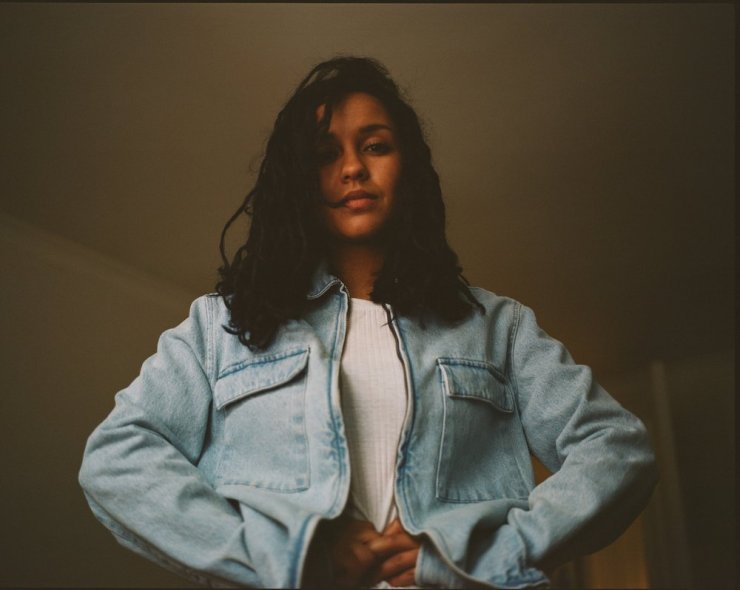
Gazelle Twin & NYX Electronic Drone Choir to perform ‘Deep England’ as part of EFG London Jazz Festival

A unique artist with razor sharp vision and uncompromising creativity; Gazelle Twin (aka Elizabeth Bernholz) has paired up with the NYX electronic drone choir once again to perform ‘Deep England’; a hair-raising transformation of her recent album Pastoral, which exhumes England’s “rotten past” and questions its uncertain future. The performance will take place on 20th November at Southbank Centre, as part of the EFG London Jazz Festival.

The collaboration was first commissioned and performed in December 2018 as part of a collaborative series at London’s Oval Space, but now Bernholz’s operatic voice will be displayed in all its glory alongside the equally as powerful voices of the NYX choir in the prestigious Queen Elizabeth Hall.

Together, Bernholz and NYX use their voices, acoustic glitching, polyphonic overtone and ambient textures to bring Gazelle Twin’s Pastoral vision to life. The unique choir explore and test the limits of organic and synthetic modulation to explore the entire spectrum of collective female voice as an instrument. Their veiled Handmaid’s-Tale-esque silhouettes are a formidable sight on stage, so expect to be blown away by the power and the glory of their live show.

GIHE will be at the show, and we urge you to grab a ticket for it here.

For more information about EFG London Jazz Festival events, click here.
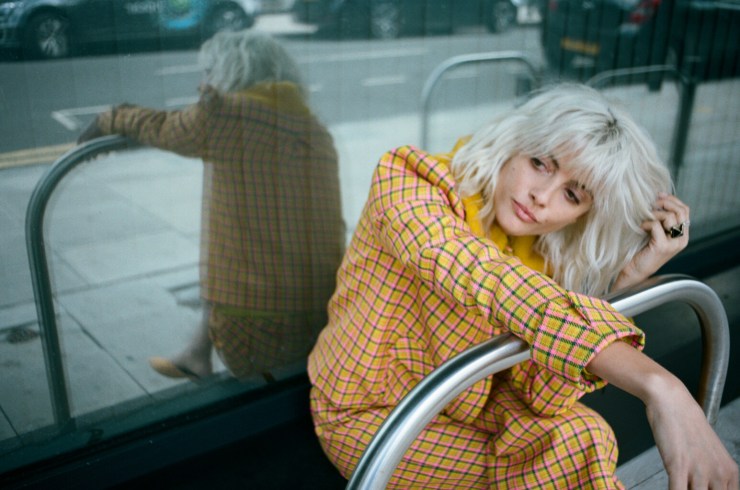
INTERVIEW: Noga Erez

When I meet Noga Erez in Clapton, East London, on a Sunday afternoon, she’s trying on suits for an upcoming photo shoot with her Stylist David Evans. There’s a vintage-looking Mulberry suit, an incredible “Beetle-juice” striped number (David’s reference) as well as a colourful pink & orange play suit. “There’s something psychological about play suits, you always need to pee when you’re wearing them” jokes Erez, and I nod enthusiastically because I know the #playsuitstruggle.

I feel at ease around her; her clothes and her comments are practical as well as cool; a great combination in an artist who has been on the rise since the release of her debut album, Off The Radar, in 2017. I ask her what she’s most proud of about this record: “Because of the many things surrounding the making of the album, and the people I partnered up with, I was able to really make it my way and keep it very authentic. That is something that I feel I had to challenge with the new album, ‘cos making a second album is always kind of a reflection on your first, and there are expectations. Whereas with the first, no-one expected anything of me. That’s the spirit that I want to maintain: something that is very authentic and not compromising in any way.”

This defiant spirit underscores her second LP, which is set for release in 2020. There has been a minor compromise though, but not in a negative way. Together Erez and her partner Ori Rousso have written “too many songs”, so they need to refine their track list: “We’re in a situation where we have a lot of songs to choose from right now. Maybe we have to say goodbye to some of them and release them separately. We’ve been writing so much music, and it’s been over a period of over more than two years, so  it kind of feels like the ones we wrote at the beginning are not the same as the ones that we write now. It’s weird, an album is a documentation of chunk of a person’s life, it’s spread over what feels to me like such a long time, it’s going to look like an album from different periods of time.”

This idea of documentation is something that fans and journalists were quick to pick up on after her debut release. In a 2017 interview with The Guardian, Erez said she had been called “brave” for speaking out about the conflicts in her hometown of Tel Aviv. I ask her if she still thinks its necessary to confront these issues alongside her music, and her response is incredibly diplomatic: “I am in no way a politician or an activist, or anything like that. I’m considered to be politically aware. During the time that I wrote Off The Radar, I was kind of obsessively connected to what was happening. I get periods of time in my life when I’m more like that, and sometimes I’m the opposite. Anything that has to do with the media especially, I feel like the more I read it, the more I get a different perspective. I’m just being flooded with information. It’s so hard for me to tell what is reality, and what is not. Being confused is one thing, but also feeling like someone wants me to be confused is another. So I just want to shut myself off and not be touched by that every now and then.”

“I still feel like I would have to handle the fact that this is where I come from, but what I gradually discovered is I never needed to talk about it as much as when it was included in the album campaign. It was weird to me. But, that story made me stand out in a way, so I feel like if I want to be very selfish, I would probably still continue to talk about it as I can’t really avoid it, I’m going to be asked about it, so I still try to maintain to some kind of connection with what is happening. But I really do feel like the best thing that I can represent right now that will be really genuine is how very confused I am about everything. The only thing I can say is that I have no idea. We look for people who tell us things, accurate things, but I cannot provide that about where I come from, or about this world, and I kind of feel like the problems of my country are minor problems. The world has bigger issues, the more the conversation becomes a global conversation, I think there’s a benefit for all of us to start talking beyond our boundaries.”

“There’s such a nationalistic kind of conversation going on about taking care of the poor people of your country, or the political problem of your country, or the surrounding countries. But the thing that we should all try to consider is our main problems, as of today, are global problems. The more we talk about the world in a global way, the better.”

Fans of Erez’s track ‘Global Fear’ will certainly resonate with her sentiments. I change the subject back to her new album, and ask what details she can share with me. “I’m not obliged to keep anything a secret, and that’s the atmosphere surrounding this whole new project. The first album, I needed to tackle more political issues. It felt to me like I had to explain to people that the fact that I come from that place, doesn’t mean that I represent what that place represents. Now that I feel like I’ve checked that box, it’s a more personal album. I feel like it’s kind of a cliché to say “it’s my most personal project yet”, but I love this new album so much that I don’t want to give up any of the songs.”

“I kind of feel like this album is going to be divided in to sections. Parts of it still deal with more global issues and things that have been going on in the world that I still have to reflect on, but there’s a personal side to things because these past two years after releasing Off The Radar were an amazing two years career-wise, but at the same time personally, we dealt with Ori’s Mum passing away. She died of cancer, and she wanted to die at home, and we saw her in the process of that. There was so much to process – so many amazing things – but so many fucked up things. It was just a mixture of all of it at once. Which is life! But sometimes you feel that everything is intense on both sides, so that is a major part of it. And also, having the perspective of being an artist that already has some music out there, and realizing what being an artist and being a persona is all about. That’s where it touches.”

Blending the personal and the political is something Erez does exceptionally well, as some of her standalone singles ‘Bad Habits’ and ‘Cash Out’ (feat. SAMMUS) have shown. I’m particularly intrigued by the video she created to accompany ‘Cash Out’. The visuals tell a story of a society without men, where women are left to fend for themselves, pitted against each other in punishing street-fights. I ask her about the creative process behind these visuals, which prompts her to talk about the development of her lyricism: “The songs take you to places. Whenever a song is done – I’m going through this process now with the second album – I realise that after writing the lyrics, I understand them so differently. Sometimes, you understand them immediately, but with other songs you leave them behind and when you read the lyrics again you’re like “what the fuck was I talking about?” This is why I love this second album so much, because I’m reading the lyrics and I’m like “I can’t believe I wrote this!”. This is a perspective that I didn’t even know that I had.”

“The thing about words, they are so deceiving. Words are the worst form of communication. I feel like music is so accurate. It captures something in a way that words could never do. But the fun thing about words, is that you meant something, but then you can forget about it, and when you come back to it, it means something so different. It feels like you are reading something that was written by someone else. That’s kind of how my videos are made. With ‘Cash Out’, I was basically writing a checklist of how to be a very strong and successful woman in today’s world. It’s the most cliché checklist: “eat breakfast / not too much / be skinny / not too much…” all those things and a lot of contradictions in between. Then, when I re-read the whole thing, I felt there was some kind of internal violence to it.”

“I feel like sometimes the voices that I have in my head are extremely violent. I am being very violent towards myself. In a way, I feel like that is a very female thing. I don’t think Ori – my partner in life and in music – struggles with the same inner conflicts or inner violence. ‘Cash Out’ was just me taking the violence that I have in my head, those voices that keep telling me to do something – it doesn’t matter how well I’m doing, they are still there – it’s never enough. So the women in this ‘Cash Out’ world are all me. And I’m taking myself in to a battle scene, a fight scene, and I put myself in front of my other self and go ahead and let them kick each other’s asses. I never thought about that when I wrote it, but that’s what happened.”

It’s strangely comforting to hear that Erez struggles with self doubt, like so many women in both the music industry and in wider society. I attempt to reassure her by saying that her persona is formidable, showing no signs of insecurity, and that both her music and her performance style translate as incredibly confident. Her reply is very diplomatic: “I’m happy that I’m able to be very frank about the fact that that’s just not the case. I think it’s hardly ever the case. There’s something very selective about the way I choose to present myself, like all of us, I deal with a lot of shit that is pure weakness, and things that I have to tackle in myself. There’s a lot of insecurity in me, but then eventually I become more aware of the fact that weaknesses are something that you have to grab on to and say okay, that’s the most valuable thing in life. Failures are the most valuable lessons in life. If you get straight A’s in tests – then good for you – but if you fail a test, then it’s the best possible scenario. Easier said than done, but that’s where I’m trying to go mentally.”

I ask about her collaborations with SAMMUS and ECHO, and if she consciously collaborates with other female rappers. As the words leave my mouth, I already feel like I have made a mistake by bringing gender in to the question. This is something I strive to leave out of the majority of my interview questions for GIHE, but today I’ve slipped up and I’ve left it in. But, as Noga has just pointed out, mistakes are valuable, and her response is authentic: “No, I don’t seek to collaborate with any musician because of their gender. Gender plays a very minor role. The one thing that I hate, is when I read about “female rappers”, that kind of gives me the cringe, even though I know it is necessary from the standpoint of people who write about music, and even from the standpoint of someone who reads it.”

“We’re still in a place where you have to add “female” to everything. It’s a language thing, it’s so weird. In Hebrew, you have a gender for every word, in English you have to add something in order for it to be gendered. That’s why words and language can be so fucked up, because it changes the atmosphere about everything. So in English, you have to make that distinction sometimes, which is sometimes for better, sometimes for worse. In Hebrew, I feel like the fact that you have a word for a female singer and a male singer, doesn’t give you the option to look at things from a non-gender perspective. I think about these things so much, but I have a collaboration with a rapper on my new album who happens to have a penis, I really truly don’t give a fuck about none of that. It just has to really feel right. Both ‘Chin Chin’ and ‘Cash Out’ are songs from a female perspective. So it made sense to work with women.”

“I find myself needing to balance the issue of gender whenever I have to curate a playlist. What I do immediately, naturally, I put a lot of men on it. My stars, a lot of them are male – Frank Ocean, Kendrick Lamar. Then I get conscious about that, so I add female artists in. That’s me being real with you about making a conscious decision to have some kind of positive discrimination. It’s a progress. Expecting it to be naturally what we want it to be, you have to be realistic. I feel like when I released my first album in the midst of the #MeToo movement, people were kind of putting the feminist suit on me. I’m a lot of things, a feminist is one of them for sure, but it took a place in the conversation that is larger than the role that is actually plays in my life.”

Her honesty is refreshing, and I re-frame the question, asking her what she thinks makes for a good collaboration. “That’s a good question, especially as I feel collabs have become like a marketing thing, more than they are an artistic thing. But I don’t judge, I think collaborations are great, so the most important thing is that the person that you have on your track gives a really good new perspective to the subject that you were tackling. That’s what happened to me with SAMMUS. When she sent that verse for ‘Cash Out’, Ori & I were at home listening to it, and we were both reacting the same – “Wowwww…what the fuck did she just do!?” – that is how it should be.”

“I knew her music for a while, and I knew she was an amazing lyricist. She’s a poet, and there’s something about her voice, and where she comes from, and her background; I knew it was going to be something different. The song’s concept is a list of things you have to do to be a “good woman”, a “strong and successful” woman even from a feminist world. So my list was so different to hers. In my list, you have to be skinny, but in her world as a woman of colour, that’s just not it. It was one of the things that made me realise that we’re not all in the same boat, you know? We’re in the same boat in the sense that we are being told what do to, who to be, what to wear and what to look like, but that varies depending on who you are. When we are all seen as “women” it flattens it, I feel. So a good collaboration would be having someone twist something so well that it helps you learn something new.”

I ask her what she learned from her collaboration with Israel’s esteemed Camerata Orchestra in 2018. Renowned artist Shlomi Shaban invited Erez to perform re-worked songs from her debut album at Tel Aviv’s prestigious Performing Art Center, and it was captured on film and recorded as a special release titled RaDaR Reworked. I also ask her about the practical side of rehearsing with a live band, as usually she performs solo. “It’s good that you mention rehearsals, because there weren’t many of them. I got this opportunity handed to me, funded by someone. It was perfect. They did a lot of performances, but I was the only one who brought 80 microphones to the venue and recorded and filmed the whole thing.”

“Ori mixed it and it was crazy, such hard work, but I knew that I had gold in my hands. For me it was surreal, because I always imagined myself with an orchestra, but it was something that was supposed to come so much later. We’d started preparing all of the orchestrations about a year in advance, and the reason we had to prepare it so well was because we had only one rehearsal with the orchestra. Unfortunately, that’s how it is with orchestras who don’t have a lot of money. It made it an even more stressful experience, just getting used to the atmosphere of having this whole thing behind me, I would have loved to have spent more time with it.”

“Honest to God, I had a really bad time the two weeks before that show. I wasn’t able to sleep, I wasn’t able to go to the bathroom, so when I got on stage I was a mess. It came out great, but I feel like I had to compensate for a lot of it afterwards in the process of mixing and keeping it dynamic. There’s something dynamic about an orchestra, there’s something dynamic about classical music. Sometimes it’s really soft, then it goes really loud – and I knew that because I’m coming from a background of studying composition, so the dynamic thing was so important to me. I wanted to tackle that as a performer, but that was the one thing that just did not happen. It was loud and stressed, but luckily that is something you can easily fix in mixing. Honestly, the process was a disaster” – she laughs at this comment – “but Ori was able to do such a great job with helping that sound dynamic.”

It’s mad how even when she doesn’t feel like she’s at the top of her game, Erez still creates captivating music. I ask her what artists are currently captivating her: “I’ve been coming back to the latest James Blake release in the last few days, because the first time I heard it I didn’t actually like it, but it grew on me. Also, Tkay Maidza. She’s an Australian rapper. I would love to collaborate with her. I discovered her through a collaboration that she did with a band called J-E-T-S. She’s fabulous. She also just did a song with JPEGMAFIA called ‘Awake’. I love her.”

My time with Noga Erez is now up, so I thank her profusely for her willingness to answer my questions, and for making such an addictive debut album. She hugs me goodbye, but before I leave, she asks “So, is Get In Her Ears a play on “Get In Her Pants”?” I laugh sheepishly and explain the only thing I’m trying to “get into” are good records, and interesting interviews with artists I admire. With Noga Erez, I’ve accomplished exactly that.

Follow Noga Erez on Facebook | Twitter | Instagram for more updates.

Photo Credit: Timo Kerber 

Kate Crudgington
@KCBobCut

Premiere: Siv Disa – ‘Moths’

New York based artist Siv Disa is now ready to share her poignant new single. Produced by fellow New Yorker, Sam And The Sea, ‘moths’ is a poignant reflection on the captivity of love.

Propelled by eerie, atmospheric hooks, ‘moths’ showcases Disa’s soaring raw vocals alongside a spellbinding majesty. As profound lyrics flow from an ethereal plane, it’s an utterly captivating offering that shimmers with a subtle mystical power. Of the meaning behind the track, Siv Disa explains:

“You see these impossibly large moths trapped in big street lamps, flying inside them and hitting the glass again and again… They must have gotten in when they were small enough to fit, and then grown too large to escape. The amount of time they spend on the wrong side of the glass. It seems so unnecessary from the outside. A whole life spent looking out at the world… For most of my life, love has meant captivity — you are at the mercy of whoever it is you love. After a destructive relationship a few years ago, I removed my emotional self from my physical self. I don’t think people can see moths or what they’re trapped in. I don’t think I can either. I don’t think I’m a lot different than those moths, except I think about them a lot and they probably don’t think about me very much at all.”

Directed by Siv with videography and photography direction from Evan Alexander Moore & Sanchez Murray, watch the hypnotic, yet disconcerting, video for ‘moths’ here:

‘moths’ is out 15th November via Trapped Animal Records.

Mari Lane
@marimindles

Introducing Interview: Eliza Shaddad

Having received praise from the likes of Rolling Stone, Mojo and The Sunday Times for her 2018 album Future, confessional artist Eliza Shaddad has also shared stages with big names such as Kate Tempest, Lucy Rose and James Bay.

Creating her unique brand of shimmering dream pop with a gritty edge, Shaddad has just released new single ‘Girls’.

We caught up with her to find out more…

Hi Eliza, welcome to Get In Her Ears! How are you today?
Hi! Thanks – I’m good! Excited as it’s release week!!!

How d0 you initially start creating music?
I create alone initially, I write the songs on guitar, and demo them in logic – programming in drums and trying out ideas for bass and backing vocals, sometimes for strings and horns. And then it’s all about having the right connection with an engineer or producer to bring it to life.

Your new single ‘Girls’ is out now – can you tell us what it’s all about?
Sure – Girls is about growing up really close to someone who has to deal with a lot and is finding it hard to cope, what it’s like to be on the outside of that, trying to get in.  

You’ve been compared to the likes of Julia Jacklin and Marika Hackman, but who would you say are your main musical influences?
I grew up on bands like Hole and Skunk Anansie, and solo artists like Tori Amos and Alanis Morrisette, they’ve had a big influence. Guitar-wise, I guess a lot of folk music like Bob Dylan and Jewel, and then more recently guitarists like John Frusciante have really inspired me.

How is your local music scene? Do you go to see lots of live music?
I’ve lived in London for 10+ years and obviously it’s next level here, especially for seeing new ideas and genres,  but recently I’ve been spending a lot of time in Cornwall writing and recording and am looking forward to seeing some good local stuff there, I’ve seen some great folk so far.

And what can fans expect from your live shows?
Whether it’s solo or full band, it is raw, dynamic and emotional. I think playing live is my favourite part, so our shows are always full of dark fun.

As we’re a new music focused site, are there any new/upcoming bands or artists you’d recommend we check out?
So many! CHILDCARE are a brilliant band who I’m sure you’ve heard of. Emma is the bassist in that, and her solo project Saint Clair is just gorgeous. Liz Lawrence is sick too.

And how do you feel the music industry is for new bands at the moment – would you say it’s difficult to get noticed?
If you’re trying to get noticed by a traditional major label, and you want their help for development then yep I think it’s probably more difficult than ever. But, if you’re mainly aiming to connect with people and know what you want to say and how, then things like Spotify, Bandcamp, and YouTube have made that a lot easier.  You can get noticed much more easily by fans and that’s the most important connection really.

Finally, what does the rest of 2019 have in store for Eliza Shaddad?
We’ve actually filmed a recent live show, which will be the music video for ‘Girls’, and will be releasing the rest of the EP to follow.  I also have some amazing shows to announce, and I’m in the middle of writing LP2 so it’s all go till Christmas!

Big thanks to Eliza for answering our questions!


‘Girls’ is out now via Big Indie Records.