INTERVIEW: Gazelle Twin

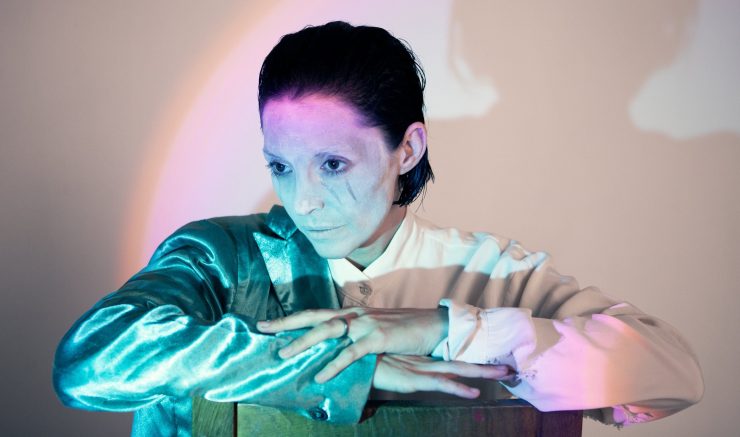
Elizabeth Bernholz’s life is inherently strange. Whether she is talking backstage with Gary Numan about ghosts, creating dark and exhilarating electronic music under her moniker Gazelle Twin, or immersing herself into normal family life; she embraces the oddity of it all.

Last time I spoke with the producer, composer and visual artist in April 2022, she was in her home studio, reflecting on the tenth anniversary of her debut album, The Entire City. She expressed that she was still using her music as “a way to get through life” and hinted that there was more to explore through this medium. What she was subtly alluding to was her fourth full-length record; the shadowy, spine-tingling Black Dog, released in October last year via Invada Records.

Usually veiled by costumes or characters for all of her work as Gazelle Twin, one of the most startling elements of Black Dog was that Bernholz had removed her mask. Facing her demons with no shield, this bold act paved the way for an exquisitely raw, truly haunting piece of art, on which Bernholz reflects on her experiences with the paranormal, postpartum depression and the powerful fears and inner forces that direct us through life.

When Bernholz performs the album live, it’s another beast entirely. Falling somewhere between a dark lullaby and intense sleep paralysis; Black Dog shape-shifts between plaintive and poignant, ghastly and graceful, as Bernholz switches between spotlights and shadows, standing and seated. She will be bringing this hair-raising performance to Birmingham’s Supersonic Festival on Friday 30th August. Eclectic acts such as Grove, Emma Ruth Rundle, Mary Lattimore and One Leg One Eye will also be playing the festival across the weekend (tickets are available here)

“I love Supersonic, it’s my favourite festival in the UK,” she smiles. The last time Bernholz featured on the line-up was in 2018, performing tracks from her third record, Pastoral. “It’s always a really great crowd and I really love Birmingham as well. This will probably be one of the last Black Dog shows that I do in its current form, too. I’m looking forward to it.”

To date, Bernholz has only performed Black Dog at a small number of venues across the UK since its release in 2023. There are several reasons for the limited shows, including production and logistical touring costs. But there’s another factor too. Bernholz explains that with this particular record, due to its deeply revealing and personal nature, there is a strong emotional toll that comes with each performance.

“Some of the very raw emotions that were pouring out into that record are still being lived now,” she reflects. Bernholz is referring to going through pregnancy, childbirth and motherhood for the second time during the Covid-19 pandemic, and how this led to her excavating her past. “I’m obsessed with the past, which is probably no surprise by now,” she laughs. “I’m one of those people that’s constantly trying to process those periods of my life. Those formative years where you’re working things out and who you are – I’m still doing it. So a lot of those questions that came up are still not answered and still part of my creative occupation really.”

This instinct to examine and understand these parts of herself is part of the process of performing Black Dog live. She comments that layering things with “weirdness” and a “dark charge” allows her to inhabit “another world” when she is on stage, which makes things more manageable, but she was initially very nervous about sharing it with live audiences.

“I do still find the shows hard,” she reveals. “I sit down for a lot of it and I’m making eye contact with the audience, so I make myself as vulnerable as I can be. After a show, often, there’s a lot of adrenaline and tears and I haven’t always had that. I [usually have] adrenaline, anxiety and then a lot of exhilaration. It’s been a journey. I am enjoying the shows, but they are a bit of an ordeal as well. I’m okay with that. It feels like I’m doing something important for me, at the very least, and hopefully that does come across to audiences as well.”

As with all things, time has helped to ease some of this anxiety, which Bernholz likens to the process of being tattooed. “There is a certain degree of numbing that happens. The pain is really intense at first, but then it becomes okay and it’s quite nice. I’m at that stage now, mid-tattoo, going with it and trying to make the most of it. I’ve been doing a lot of shows in places I’ve never really done before, so that’s been really nice.”

In addition to her “momentous” sold out headline show at London’s historic Bush Hall – more on that to come – Bernholz has cherished the opportunity to connect with new audiences in new locations on this tour. “I’m not a massively touring artist, but when I get the chance to do a gig in a place where I’ve never been before, I’m always really happy to do it,” she comments. As part of the first run of Black Dog shows, Bernholz performed at The Glass House in Newcastle, which marked her debut gig in the North East.

“It’s a big classical venue and the people that came along to that were a total mixture,” she recalls. “A lot of people took a punt on it, it was something quite new to the venue, maybe a bit weirder than their usual programming. I had a chat with a couple of music students afterwards and they were just surprised and happy that they’d got to see something like that in their city. It made me feel good.”

Bernholz is also looking forward to returning to play in Glasgow in September. “This show, compared to my previous set ups, is more expensive,” she willingly admits. “There’s more people involved, there’s a baseline of tech requirements that we have, and proper staging and production. So the chance to do stuff away from London, with this level of production is great.”

A common thread that connects the places and people that Bernholz performs to is gratitude. She instinctively taps into the atmosphere of each location, something which is especially true of her London show at Bush Hall last year. “I love London gigs. I have an amazing following there and I love visiting London as much as I can,” she enthuses. “I think it is a bit of a beacon, so if something works in London, you can trial it to a bigger audience first, and take it further out.”

She continues to reflect on the “epic” nature of her London Black Dog live debut. “I was so anxious. The sound check didn’t go particularly well, we had a haunted sound desk,” she smiles. “I was in a weird zone before the show. I felt supercharged with anxiety. I think, being an anxious person generally, I’m always on some level of tension, but it was ramped up. But it did me a favour, because the show was actually a huge release.”

Bernholz’s anxiety about performing is not rooted in insecurity, it comes from a place of wanting to bring the intrinsic worth of her visions as Gazelle Twin to life. “I’m more sure of myself on that stage than at any other time in my life,” she shares. “I love that experience, it’s like having a lucid dream. As somebody who is socially not amazingly confident – suddenly being a person that can eyeball people and be incredibly vulnerable at the same time – it’s like getting to live a different life for a bit. I loved the Bush Hall show. The energy in the room was extraordinary. I could feel electricity in the air.”

As a spectator at Bush Hall, I can confirm that it was an exceptional performance. Bernholz’s necromantic spirit and otherworldly vocal range ricocheted off the archaic walls of the old music hall. The crowd of fans and friends were silent and spellbound, including electronic music pioneer Gary Numan. “Gary and his family came backstage afterwards and then we just spent about an hour talking about ghosts,” Bernholz shares. “The whole thing was like an insane dream. You can’t make it up, really.”

A new dream that Bernholz will be making a reality in the near future is a specially commissioned show at another prestigious London venue. In November, she will be performing alongside the London Contemporary Orchestra at The British Library, on a Black Dog inspired piece that will open the venue’s new season, Tales of the Weird: An Autumnal Festival – a celebration of the strange, the uncanny and horror. Ticket holders will also have access to the new exhibition, Medieval Women: in their own words.

“It’s a perfect positioning to present Black Dog in almost an acoustic form,” Bernholz shares. “I’ve been saying that it will be like the ‘Victorian version’,” she laughs, before adding “that sounds awful actually.” Bernholz insists she won’t be “cosplaying as a Victorian”, but she will be transforming the intensely layered and electronic music of Black Dog, offering her listeners a new perspective on the record. “Weirdly, when I was writing Black Dog, I had orchestral scale in my mind,” she shares, “I kept that, with the hope that one day we could do this version and hopefully record it as well.”

Bernholz has collaborated with conductor Robert Ames before, but she is especially excited to work with the London Contemporary Orchestra for the first time. “It’s a brilliant opportunity to be able to do that within the majesty of The British Library as well, with all of that incredible literature and history around,” she comments. “I’m so excited. Hopefully we’ll be able to transport it as well, and do it a few more times. Hopefully in the UK and maybe abroad as well.”

2024 continues to be a busy year for Bernholz. As well as balancing her Gazelle Twin performances alongside her normal everyday life as a parent, she is also preparing to acknowledge the 10th anniversary of her second album, Unflesh. Released back in September 2014 via her own imprint Anti-Ghost Moon Ray, this Gazelle Twin record marks a significant point in my own life as a music fan and journalist. It changed my idea of what electronic music could be, so I suspect it holds a deeper reverence for the creator.

When I ask how she feels about the upcoming anniversary, Bernholz jokes that it makes her “feel old”, before revealing that she considers Unflesh to be her “true love” album. “I think I hit on something that I have never been able to get rid of – I hit what Gazelle Twin truly was meant to be for me,” she explains. “I look back on Unflesh and I just think ‘God, I’m so glad I did it, and I did it without giving a shit about how it was going to do, or what it was. It was just urgent and I just went for it without any expectations.”

Much like the inception of Black Dog, on Unflesh, Bernholz was exorcizing a lot of pent up emotions. “It was a huge thing for me, coming out of a past mental state which I hadn’t acknowledged until I’d made the album,” she recalls. “It was like this floodgate situation that allowed me to be creative with expressing those types of things. I think even beyond that, Unflesh has just been a bit of a template for how I approach making things. I don’t know how I’ll feel about Black Dog in 10 years time. I made it how I wanted to make it, but it’s funny, these things have a different meaning to you when you’re the person making it.”

This key “difference” is that Bernholz says she can listen back to Unflesh, and it doesn’t provoke a “horrible full body cringe” and force her to contemplate what could have been added or edited, which is something she has experienced when reflecting on other works. “I can still listen to that album – and this isn’t to pat myself on the back – but I am proud of that work. “I still think there’s mileage in it and more to take from it,” she explains. “I think there’s mileage in that visual world. If there was another chapter, what would that be? [What if] it was in a different form, like a book?” she extrapolates.

Fans will have to wait until September to find out exactly what Bernholz has planned…


Follow Gazelle Twin on bandcampSpotifyInstagramTwitter & Facebook

Photo Credit: Teri Varhol
Kate Crudgington
@kate_crudge

ALBUM: Divide and Dissolve – ‘Systemic’

“If you can imagine something ending, then it can end,” offered Divide and Dissolve‘s saxophonist and guitarist Takiaya Reed during an interview with Get In Her Ears back in 2021. Visualising a world without injustice is at the core of what Divide and Dissolve do. Their uniquely heavy sound is designed to erode the foundations of colonialism and liberate the land for indigenous communities.

Since the release of their debut album, BASIC, in 2017, Reed and her bandmate percussionist Sylvie Nehill have been honing their unique form of gargantuan-yet-graceful noise in order to help cauterize the wounds of colonialism. Their 2018 album, Abomination, and third record Gas Lit (2021) continued this necessary aural purge. Now, the band have shared their fourth offering, Systemic, and it’s equally as commanding and as poignant as its predecessors.

Released via Invada Records and produced by Ruban Neilson of Unknown Mortal Orchestra, Systemic continues to push Divide and Dissolve’s essential, empowering message into the ether. Fuelled by Reed’s distinctive, doom-ridden saxophone sounds and Nehill’s phenomenal percussion, the nine tracks that make up Systemic seek to undermine the separateness that colonialism enforces, and instead, engage listeners from all walks of life, uniting them in a sometimes blissful, but more often blisteringly heavy cacophonies of resistance.

From atmospheric opener ‘Want’ and the beautifully dense sounds of ‘Blood Quantum’, through to the majestic closing track ‘Desire’, Systemic is permeated with an altruistic blend of both overwhelming fury and unyielding optimism. Whether listeners are being pummelled by the crushing beats and riffs on ‘Simulacra’, or being lulled by the striking, melancholic sax sounds on the intro to ‘Indignation’ – before being hit with an obliterating volume shift two minutes in – Divide and Dissolve’s dynamic instrumentals assault the senses and reflect the complexities of the emotions and concepts they’re inspired by, including the strength of non-verbal communication.

The only words on Systemic are uttered on ‘Kingdom Of Fear’ by Minori Sanchiz-Fung, who the band have worked with on their previous records. “I have pleaded / let me return these songs to the dirt / cognizant of the wound / that has yet to heal” the Venezulan artist quietly urges, articulating and acknowledging the dispossession that occurs in the aftermath of colonial violence. This message resonates deeper alongside the band’s sublime, drone-like score.

Changing the heavy music landscape one record at a time, the patience and empathy that underscores Divide and Dissolve’s sound inspires a deep sense of awe and respect. “The album is a prayer to our ancestors,” Reed offers about Systemic, and what an awe-inspiring ode it is.

Divide and Dissolve’s new album Systemic is available to buy here

Follow Divide and Dissolve on bandcampInstagramSpotifyTwitter & Facebook

Photo Credit: Yatri Niehaus

Kate Crudgington
@KCBobCut

LISTEN: Anika & Ni Vash ft. Nasim Luczaj – ‘No Fly Zone’

An evocative, sonic form of resistance, ‘No Fly Zone’ is a fundraising collaboration between Iran-based musicians Ni Vash and Berlin-based musician Anika. Released via Invada Records, all profits from this track will go directly to support a UK-based charitable organisation – who have asked to remain anonymous – who are campaigning for human rights, women’s equality and against government oppression via demonstrations, conferences and publications, offering legal support to those in need.

Collectively know as Ni Vash – a Persian word for “renewal” or “regeneration” – the artists and musicians involved in the project have concealed their names for their own safety. They have worked alongside Anika to create ‘No Fly Zone’, a moving effort to remind listeners that “restrictions come in many forms” and it is our global responsibility to help break down the barriers that are holding others back. You can download the track via bandcamp here

‘No Fly Zone’ is a stirring, atmospheric uprising featuring the words of Anemone, Windflower, by poet Nasim Luczaj. The anemone is known as the “windflower” because its petals close when the plant detects advancing rainstorms. The plant’s natural instincts personify a very human reaction to fear, but on ‘No Fly Zone’, Luczaj’s calm, measured narration and Ni Vash & Anika’s hypnotic synth sounds gently over ride this instinct, quietly urging listeners to do the same.

Speaking about their new collaboration, Ni Vash explain: “In Iran or anywhere, people cannot fly, cannot see their dreams materialize, even through working hard or playing by the rules. Restrictions come in many forms, from without and from within – self or society, made by cultures, we are restricted. We are surrounded by voices without words, in a no fly zone. Join us in the fight for human rights. Join us in the fight against government oppression. This is a world-wide fight. This is your fight.”

Download ‘No Fly Zone’ and donate here.

Watch the video for the collaboration below.

Photo credit: Autumn Andel

Kate Crudgington
@KCBobCut

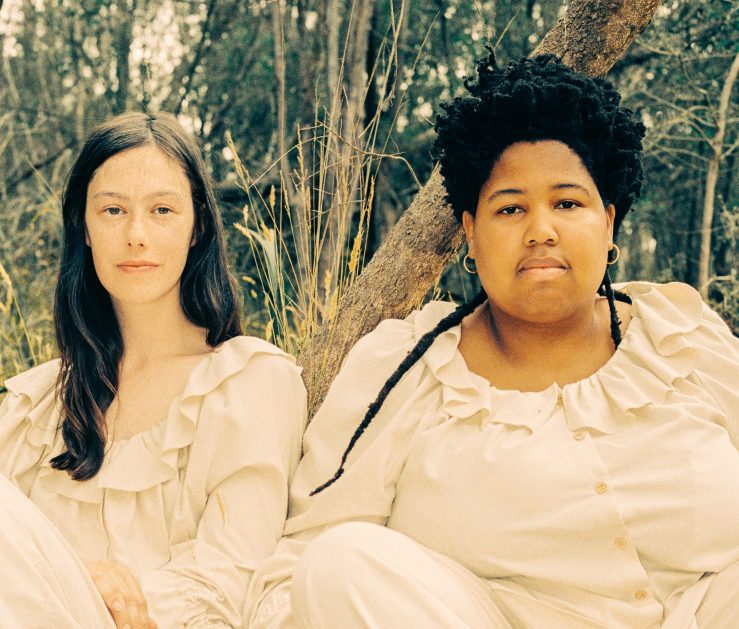
INTERVIEW: Divide and Dissolve

Fuelled by Takiaya Reed’s doom-ridden saxophone sounds and Sylvie Nehill’s phenomenal percussion, Divide and Dissolve create idiosyncratic instrumentals designed to erode the foundations of colonialism and liberate the land for indigenous communities. Flowing with a unique gargantuan grace, their second album Gas Lit has been haunting our ears since it was released in January of this year. We caught up with Takiaya to talk about the record, the reception that it’s had, the new Remix EP that it’s inspired, and a shared love for Radio 6 presenter Mary Anne Hobbs…

Hello Takiaya, how are you doing today?

I’m good, I’m in finals right now, so I’m studying a lot and trying to drink enough water to feed my brain. I’m studying psychology. It’s intense, but I feel super chill about it, because it’s all just a pseudo science. It’s kind of comical trying to find ways to talk about things that are extremely inaccessible and continuing to perpetuate all these things that are sometimes helpful, and sometimes not. The mind is so mysterious and vast, and we’ll never really know what it’s capable of…

I think you should put that in your final essay. You should just end it with that sentiment.

Yeah, they’ll be like “50 Points off for not using enough empirical evidence…”

That’s true, maybe don’t listen to me…

Musically, let’s start from the beginning. Can you remember who, or what first inspired you to start making music? And how Divide & Dissolve first came together too?

It was my dad who first inspired me. I started out playing piano but then he was like, “hey, you look like a saxophone player,” and I was like, “what? A sax player, really? I thought I should play trombone or something?” but he said “I know you’re a sax player. I play trumpet, so we could play duets” So he got me started on playing saxophone and I felt this intuitive almost spiritual connection with the instrument. I still roll my eyes at my dad for what he said about looking like a sax player, but I think there’s something to him having had that knowledge.

Then later on, I was inspired to play guitar because I met my friend Osa Atoe, who does Shotgun Seamstress and was in a band called New Bloods. She showed me how to put on shows, how to set up a PA and she told me to play guitar. Osa was super inspirational in terms of me not playing classical music, which is what my first passion was.

With Divide and Dissolve, I just had a good friend say to me “Hey, you should meet Sylvie, you two are going to love each other” and we instantly just got along. It’s not a very eventful story, it’s just more like, “hey, you’re cool. Okay, cool. Let’s play music. Sweet!” We’re both super chill people, so it just works. I’m trying to trust in that. When making decisions about life, sometimes it just feels super right, like you’re just supposed to be there. Those are probably very good guiding principles.

It sounds like you rely a lot on your intuition, which surely can only lead you to the right kind of people and the right kind of things.

The music you make as Divide and Dissolve, is fuelled by a powerful anti-racist, anti-white supremacy, anti-colonialist message. Do you feel like your music is uniting and educating people about these issues?

I can only hope that it is. It feels amazing to be able to talk about the things that we want to talk about, and be able to experience relationality with our ancestors, our relatives and our kin, and to be able to talk about the Earth in this way and just feel all the resonance. That’s just what we’re about in general. So I feel super grateful and I don’t want to take any of that for granted. I want to be able to continue to connect with people in these really positive and meaningful ways. That’s just how Sylvie and I are.

We’re pretty focused and we want to directly communicate our message. We would like the systems that continue to perpetuate genocide to end. If you can imagine something ending, then it can end. Instead of living in the world where you feel like, “oh well, that’s not possible” – you should try to believe that anything’s possible. That’s where I’m at.

That’s a really refreshing and hopeful sentiment. You do a magnificent job of making listeners feel this way on your most recent album, Gas Lit. What would you say you were most proud of about this record?

I remember having a conversation with Ruban Nielson (Unknown Mortal Orchestra) who produced the record, and I just told him, “I hope people can understand exactly what this album is about.” We put a lot of intention into the album when we were writing it. We put a lot of effort and love in, and we consulted with our ancestors. So when it was released, the way people were writing about it and talking about it felt so attuned. They knew what the album was about without me even specifically telling them what it was about. It was abundantly clear and that still feels incredibly special. It’s so amazing to want to communicate something, and then to have it actually happen. It makes me feel super inspired to continue playing music. I love that Sylvie and I get to do that with one another. It feels like such a blessing.

Do you have a favourite track on the album? Is there one that you enjoyed recording the most or one that you enjoy playing live the most?

Do you know what, I don’t feel properly equipped to answer that question yet, because we have been in a pandemic and this music hasn’t been played live. But, I feel like I’ll know the answer once we go on tour. I’ll be like, “Oh my God, it’s this song!”

The creation of all of the songs was so unique, so it will feel awesome to learn more about the album in terms of performance when we play it live. It feels so wild to be able to do such a thing, because we haven’t had the opportunity to. I’m very excited to play live. I feel optimistic and hopeful that live music will return in a way that feels meaningful and good.

I can’t wait to catch you live when you’re here in the UK. You’ve recently released a Gas Lit Remix EP, featuring tracks by Moor Mother (‘Mental Gymnastics’) and Chelsea Wolfe (‘Far From Ideal’). Talk to me about how this EP came to life…

Our label, Invada, thought it would be cool to do some remixes and I just knew who I should hit up. I feel so connected to both of Camae (Moor Mother) and Chelsea. I think they are both amazing people who do amazing things. It feels so special that they would want to work with us. It just makes me smile a lot.

I’ve just seen that BEARCAT has also remixed a track for you, which is cool!

The visuals that you’ve shared to accompany the Chelsea Wolfe remix and the Moor Mother remix – shot by artist, writer, and filmmaker Sophia Al-Maria who currently has a sculpture at the Serpentine in Hyde Park – compliment the songs so well. 

I love music videos. I don’t know how to make them myself, but the visual world is so interesting. I love it when people who have an understanding of it decide to connect with us and tell another story. Maybe they make it deeper, maybe they don’t. It feels special to try and achieve deeper communication. I think it enhances the music and I love that. Anything that helps us to be able to feel this feeling deeper is awesome. But also, maybe the videos help you not feel things as deeply, and that’s awesome as well, because maybe that’s what someone needs.

I agree, I think there’s a nice balance between the visuals and the sounds.

We’re big fans of Divide and Dissolve her at GIHE, and someone else who also is also a big fan of yours is Radio 6 presenter Mary Anne Hobbs. How do you feel about that?

I really want to meet her, she seems so cool. Sylvie and I want to hang out and eat food with her. She’s across so much cool music, she has really great energy and it feels like such a huge blessing to have her understanding of what we’re doing. I admire her, I think she’s awesome.

We think she’s amazing too. Maybe this will be the interview that she reads and then she invites you to dinner?

Finally, what else is on the horizon for Divide and Dissolve? 

We’re going on tour soon and we’re playing Roadburn in 2022, so that will be fun!

Thanks to Takiaya for speaking with us.

Order your copy of the Gas Lit Remix EP here

Follow Divide and Dissolve on bandcampInstagramSpotifyTwitter & Facebook

Photo Credit: Jaimie Wdziekonski

Kate Crudgington
@KCBobCut