ReBalance Celebrates International Women’s Day & Interview with Cat Webb (Lighting Engineer at Union Chapel)

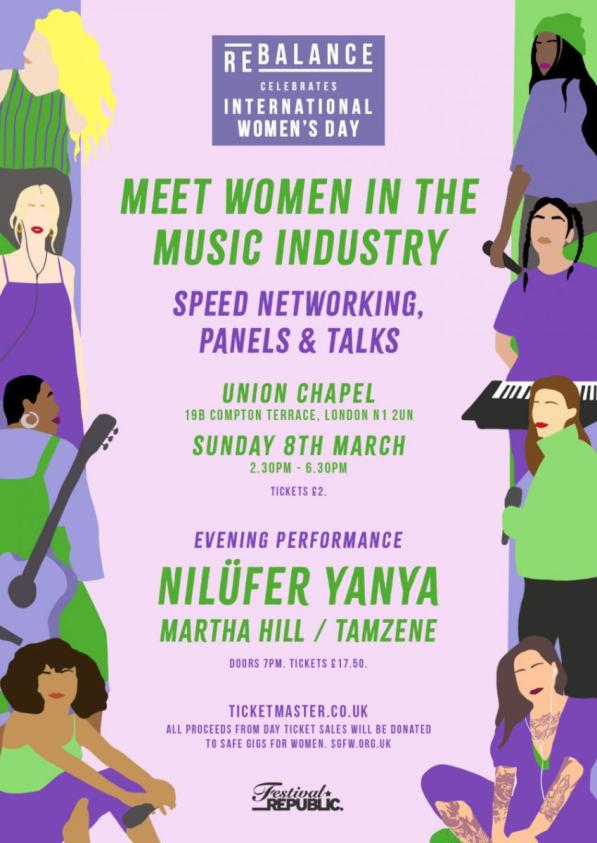
There are plenty of music events happening across the UK on International Women’s Day this year (which we’ve listed for you here), but we’d like to give some extra attention to the ReBalance event that’s happening at London’s Union Chapel on Sunday 8th March (tickets here).

Women from Festival RepublicLive NationAcademy Music GroupBig Scary MonstersSony MusicMAMAOgle HogMetropolisMelody VRNational MerchandiseBBCSafe Gigs for Women, and PRS Foundation will all be in attendance, and on hand to talk to wxmen who are looking for advice about their career in the music industry. There will also be live performances from Nilüfer YanyaMartha Hill and Tamzene.

Cat Webb, who is the Lighting Engineer at Union Chapel, has invaluable experience in an industry environment that has traditionally been dominated by men. Below, she candidly shares how she came to be a Lighting Engineer, and the challenges she’s overcome to excel in her current field.


How did you come to know about, and work at Union Chapel?
I’ve lived in Islington for years, and always passed the Chapel with itchy fingers and ambitious eyes. As a lighting engineer you’re always looking to work on interesting shows in spaces that give you a sense of awe and delight, so when the opportunity arose to join the lighting team I jumped on it.

What is your work at Union Chapel, and what does it involve?
I’m a lighting engineer and designer. Some of the time this involves looking after visiting designers, assisting with setting up their equipment or helping them use the lights we have to achieve the looks they want. The work can be technical – rigging, calculating power and programming – but a lot of the time the most appreciated quality is being a friendly, welcoming face.

However, not many bands tour with their own lighting designers, so most of the time I’m the designer for visiting gigs. If you imagine that this is a profoundly complex process involving extensive collaboration and maybe an analysis of the cultural meaning of blue – that’d be great. But the reality is that most of the time you have 4-5 hours between the band arriving and the audience, and though you can listen to sound check and have conversations in that time, maybe even be given a rough set list of songs and binge a few on YouTube if you’re lucky (and the wifi works), realistically most of the time you’re winging it. Even if you do get to hear something from an album they might play, the live version is often very different, which is both the challenge and the thrill of live music.

But! In defense of lighting designers: we are winging it based on years of experience with story, atmosphere and music, as well an understanding of light, colour, angle and the tools that are available to us. Even if I don’t know the music well, my job is to use that experience to judge where emotionally things are going, and to follow and predict in a way which catches the eyes along with the ears. At its best, good lighting adds to something that the brain doesn’t even necessarily experience as sight or sound – just a great big feeling, powerful and true.

What has it been like being female working in a male-dominated industry? What needs to change?
Things have changed a lot in the last ten years. The overt sexism that was very present when I graduated – relentless comments about my appearance, sexuality or ‘lady-brain’ – has declined, for which we can all heave a sigh of relief.

However, there’s still a long way to go. With somewhere between 6-9% of my profession being female, the mental picture people still have of lighting designers is male. Psychologically this has numerous consequences, including making it more likely that men are hired. It is easier to see the merits in someone who already fulfills your mental picture of what the person should be, and to see the flaws in someone who defies that expectation – this is human nature. The goal is to change that expectation.

I have been in more gigs than I can name where my male colleagues are addressed as the sound or lighting ‘engineer’ and I will be the lighting ‘girl’. Visiting engineers have physically started in surprise to see a female in my position, or I have been told that I shouldn’t light a certain kind of music, because as a woman I “just won’t get it”. The base-line expectation of female competence is still not there. Personally – and among many of my peers – this means we aspire to standards of excellence above and beyond, just to be treated with the same respect as our male colleagues. And if our standards drop to merely average, we are judged twice as harshly.

Qualities in a designer such as confidence, commitment, determination, expertise, or precision, are too-often called something else in a woman. Bossiness. Ball-busting. Picky; difficult; cocky. And we are social creatures; it is easier to believe that we are individually failures, than to challenge a cultural bias, let alone in an industry whose leaders, who you depend on for your ability to live and eat, are still overwhelmingly male. Women who call out the sexism are too often dismissed as “difficult” or “flaky”, or accused of making a big deal out of nothing. It is incredibly hard to honestly and openly challenge your own privileges and biases, and having these conversations with generosity is still an ongoing challenge – for all of us.

Machismo still drives large parts of the technical industry, though it too thankfully is changing. A classic example is the endless saga of whether women can lift heavy things. The answer is, of course: yes. Of course we can, and yes, it is frustrating when a woman states her capabilities, but is ignored; her competence and her word mean less than a preconception of her strength and abilities. However I will often ask someone else to help me lift something heavy, not because I’m “weak”, but because the culture of being “strong” has left so many good men I know injured. It is a culture that hurts everyone.

Both theatre and live music often correctly protects the well-being of artists, but does not extend the same human courtesy to its technicians, male or female. Hard hours, rudeness, variable pay – I don’t know any technician of any gender who hasn’t been in some way treated badly at some point in their careers, or told to “suck it up” because we work for “passion” rather than decent work conditions or reasonable pay. The Union Chapel is a fantastic part of changing this, but it’s a big fight. Actively promoting diversity is the first step to changing that culture, and making the industry better for us all.

What has working/volunteering at Union Chapel made a difference to you/your career?
I always wanted to work at Union Chapel, for the space and the music. It was a bucket-list ambition, and fulfilling it has been a privilege.

In recent years, the Chapel’s move to actively seek out female technicians has been incredibly encouraging to see, and it’s been an honour to work with the incredible teams of both male and female engineers in the venue. As a freelancer you can bump from show to show without ever feeling rooted, but the Chapel fosters a sense of community, and the team is so welcoming and good that walking through the Chapel’s doors often feels closer to coming home, than going to work.

As a listed building, lighting the Chapel has changed how I approach my work. Traditional stage lighting is about drawing the eye into only one place, zooming the senses in. At the Chapel you almost have to do the opposite, zoom out to place the music in the context of a shared space and experience. That said, while I’ve lit many gigs that will stay with me and reveled in the power of light in that space to do something big and amazing, the moment a thousand candles were lit up during the Christmas service, I was forced to admit that sometimes, just occasionally, a bit of string and wax can put the twenty first century to shame.

Finally, tell us a bit more about yourself…
I started in theatre before moving more into gigs, but probably still know more about Shakespeare than Adele. That said, I’ve now been in music long enough that every week something will come on the radio that I’ve lit, which is pretty damn cool. I have mild synaesthesia, so I often hear and feel things in colour; I’ll hear a song and see the colours I lit it with long before I recognize the actual band.

I volunteer for the Green Party, and as well as studying a martial art I also sometimes teach women’s self-defense. I hope that none of my students ever have to fight to protect themselves, but I believe that it’s easier to talk your way out of trouble if you know you can also defend yourself, and that crucially you believe in your own right to do so. I also write novels, initially as Catherine Webb and Kate Griffin, and more recently as Claire North.

Get In Her Ears w/ Nun Habit 05.03.20

Kate and Mari were back in the studio this week with all the new music to celebrate International Women’s Day, including tracks from Karen O, Belako, Nova Twins, Taquirah, Why Bonnie and New Pagans.

They were joined by Nun Habit, who entertained us with the wit and musicality of exclusive acoustic renditions of two of their tracks.

Listen back here:

Tracklist
Karen O & Dangermouse – Woman
Nova Twins – Vortex
Noga Erez – Views
Shea Diamond – I Am Her
Tina Boonstra – Out Of My Depth
Actrese – Lola
Pom Pom Squad – Red With Love
Wargirl – Dancing Gold
Beach Riot – Tune In, Drop Out
Deaf Surf – SOFA
Dream Nails – Payback
LIME – Surf n Turf
Belako – Tie Me Up
Johanna Glaza – Exile
Jemma Freeman & The Cosmic Something – Black Rain
New Pagans – Admire
Why Bonnie – Voice Box
Taquirah – Feel
Faber – Time
Matthew Barton – Fag
Ali – No More Trying
Jess Fitz – I’m Fine
Alanis Morissette – You Oughta Know
Eurythmics & Aretha Franklin – Sisters Are Doin’ It For Themselves

Track Of The Day: Grizzly Coast – ‘Forever’

A thoughtful, anti-romance anthem for those struggling to end an unhealthy relationship; Grizzly Coast has shared her latest single, ‘Forever’. Full of luscious guitars and dreamy vocals, the Toronto-based songwriter has crafted a sad, but ultimately uplifting listen.

“We’re doomed, but I want you in my room” sings Grizzly Coast (aka Alannah Kavanagh), revealing both a strength and a vulnerability that underscores the majority of her songwriting. From ‘Half Light Boy’ to ‘High-Functioning’, Grizzly Coast’s hyper-awareness of herself and her subjects – relationships, self autonomy, and struggling with OCD – give her songs a poignant, intensely relatable quality.

If you’ve ever felt lonely, but lethargic at the same time when it comes to a past relationship, Grizzly Coast’s ‘Forever’ is a must listen. Click play below, and follow Grizzly Coast on Facebook & Spotify for more updates.

Kate Crudgington
@KCBobCut

ALBUM: Post Louis – ‘Descender’

From the office to the tour bus, Stephanie Davin has spent every spare moment of her time writing what would become Descender, the debut album from Post Louis. Alongside her responsibilities as lead singer and one fifth of this experimental art-rock band, Davin worked endless hours in the corporate world; eventually breaking away from the machine to push the boundaries of her creative expression in a remote cottage in Wales.

Accompanied by songwriter/co-founder Robbie Stern, and without the distractions of working life, Davin would craft the foundations that would become Descender. When their material was presented to the rest of the band, each song structure would be meticulously deconstructed and reconstructed within the walls of the Sjømannskirken in Rotherhithe, becoming a kaleidoscope of angular guitar riffs, scuzzy pop melodies, and breezy soundscapes.

Opening track ‘Fishwife’ begins with Davin asking “How do you stop an overflow?” The uncertainty felt in the midst of a “bad patch cresendoes into a cacaphony of surf guitar, pulsating basslines, and thunderous drum beats. “The angler man is sinking and the walls are rusting through and through and my love is green as the sea is blue because all I had I gave to you”

‘Stress Fracture’ features tenor saxophone, courtesy of Alex Hitchcock, tumbling over the backing vocals of guitarist Andy Stern – paralleling Davin’s emotional songwriting and off-kilter lead vocals –, whilst ‘Little Jack’ studies the pain caused by loneliness (and the wolves loneliness can create when mixed with sexual desire – “She says you’re gonna be a wolf some day”).

Don’t let the breezy intro to ‘Janaskie Pt I’ fool you… Adam Turner-Heffer’s punk rock basslines are as infectious as Mattis Moviken’s meticulous drum strikes, resulting in a thrashing big instrumental tidal wave that had me reaching for rewind. Its companion piece ‘Janaskie Pt II’, and the instrumental track ‘Labyrinthitis’, lead into the title track ‘Descender’; reflecting on the exhaustion of working long laborious hours and the effect this can have on your life – “I’m working now from evening till dawn / Sun rises up and then you are gone…”

The poetic lyrics of ‘Like Bad Dreams’ are followed by ‘Ghostwriter’ – an anomaly on Descender – which sees Andy take over lead from Davin with the opening line, “How did you stop that overflow?” However, it is ‘Winter Pollen’ that hits me hardest in the gut. When Davin was constructing this particular song, the Me Too movement was beginning to open many eyes to a world most of us were ignorant of. This bravery was followed by anger, exhaustion, but ultimately empowerment. ‘Winter Pollen’ reflects the urgency of this movement with a heavy guitar sound that provides the backdrop for Davin’s frustration. “I make music with my brothers and I love them so / But it’s hard not to be angry, hating all the time / When Brock Turner spends three months in prison for his crime / When somebody spikes my mother’s drink at our first show…”

Both ‘Angular Man’ and ‘December’ close the album; each track incorporating contrasting instrumentation. As Davin sings the final line of the album – “In my darkest hour I fear I’m not strong” – the underlying theme of the Descender becomes more apparent. A reflective and poignant collection on the exhaustion that comes with living. 


Descender is out now.

Ken Wynne
@Ken_Wynne

Photo Credit: Maya Sacks