
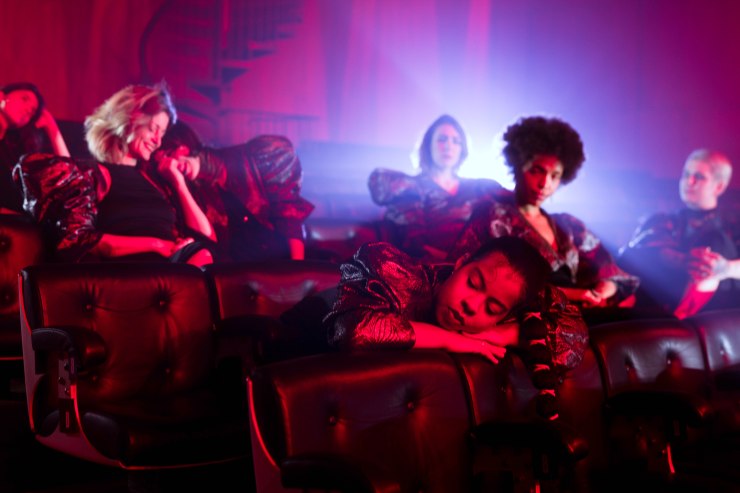
By harnessing the sublime power of the collective human voice, the NYX drone choir have crafted a unique form of psychedelic rebellion. Originally formed by New Zealand-born composer and director Sian O’Gorman, the ensemble – made up of multi-talented vocalists, artists, musicians and movement specialists – use electronics to layer and manipulate their vocals, creating their own idiosyncratic sounds and expanding what a traditional choir is capable of.
I have witnessed the immense musical alchemy of NYX many times. I saw them perform their collaborative work Deep England with Gazelle Twin – originally at London’s Oval Space back in 2018 – and I’ve seen them showcase their own work at Southbank Centre’s Queen Elizabeth Hall. Their sound enraptures, inspires and intrigues the more that you engage with it. The collective have now harnessed this deeply emotive listening experience on their debut eponymous solo album, which they have just released via their own label.
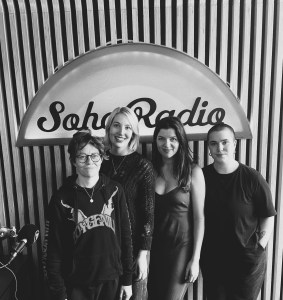
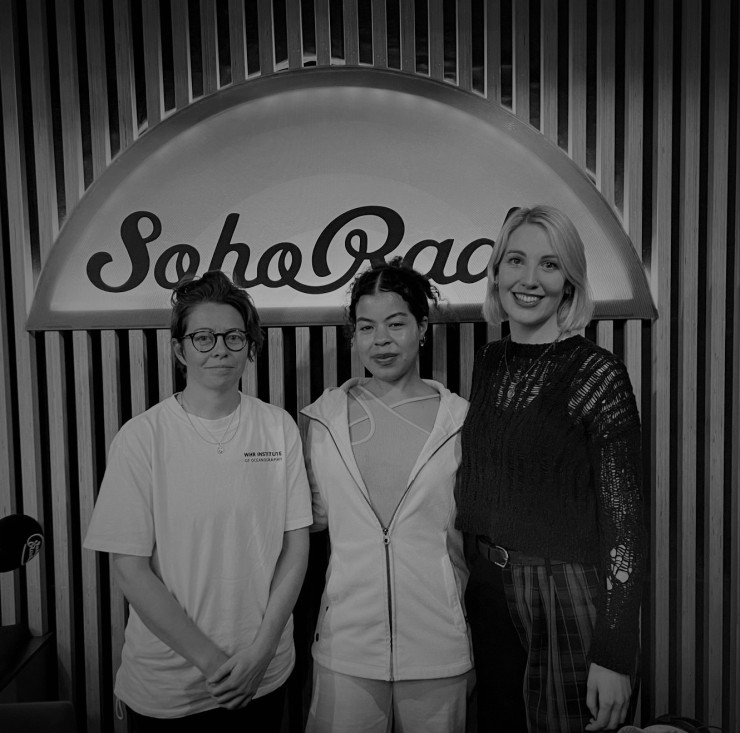
NYX is a body of work that has been years in the making. When I spoke with collective members Alicia Jane Turner and Philippa Neels on our Soho Radio show back in 2023, they hinted that we could be expecting a solo record in the near future, as well as sharing stories about their experiences of recording the soundtrack for the Diablo video game. The last time I spoke with Sian O’Gorman was in 2021. We took a deep dive into her own experiences of listening to and creating music, as well as her inspirations for forming NYX.
A lot has happened since then – most recently Sian curated the score for acclaimed BBC drama Dope Girls – but one thing that has remained a constant is her holistic and deeply human approach to singing. This becomes especially clear when we begin discussing the vocal workshops that she facilitates: “Tones, Bones and Drones”. The workshops are for singers and non-singers of all ages and genders and are focused around using the voice as a “vessel for connection”. They have been a part of her practice for a long time.
“Singing is free and anyone can do it anywhere. It seems such a shame that it’s locked out of most people’s lives,” Sian reflects. She finds it strange that people will go to a gig or a club and move their bodies and dance together despite not being technically “good dancers,” but the idea of singing or using your voice in public doesn’t seem to be as socially accepted. “It’s always made me really sad that there aren’t many public spaces for people to use their voice in a way that isn’t speaking,” she continues. “Speaking is very cognitive and thought based and heady. The way that some people speak and use their words is very embodied, but I would say in general, we’re only really using a very small percentage of our voices.”
Sian is quick to acknowledge that sometimes these opportunities – like joining a choir – are limited to those who have a technical singing ability or who can read music, but she also thinks there are other barriers to this type of expression too.
“There’s something about the voice that’s just so intimate to people,” she extrapolates, visibly passionate as she does so. “Every single time you think you’ve said something wrong, or used your voice in a way that wasn’t how you planned, or you made a noise that you think you shouldn’t have – the actual muscles shut down. They contract and it becomes harder to loosen them. So when people say they can’t hold a note, well, it would be the same for me if one day I just woke up and decided I was going to do the splits. It’s going to take me a while to get my muscles ready to build up to that. Your voice is just the same. The muscular system just needs attention and practice, and playfulness as well.”
Playfulness is at the core of what Sian encourages during her workshop practices. She explains that some attendees are too nervous to even make a noise or maintain eye contact with others when they first arrive, but the nurturing atmosphere she creates with the group gently encourages them to express themselves, culminating in a collective “sigh of relief” once they have overcome these fears.
“It always devastates me when I hear someone saying ‘Oh I’d love to come to your workshop, but I can’t sing’ – and I’m like, ‘mate, that’s the whole fucking point!’,” she laughs. “There’s so much benefit in using your voice. There’s neuroscience research and research across all sorts of mental and physical health issues that proves that singing – both on your own and in groups of people – is incredibly beneficial to your own well being.”
“Everyone that comes to these workshops has some level of vocal tension that they are working with. So it’s a very beautiful meeting ground [where we] drop all of our expectations and just have a playful time together, remembering the essence of being human and the essence of using your voice. Being in a group with others [like this] always teaches me that humans do have the power to create good stuff. We can make good things together really easily.”
Together with her fellow choir members, Sian has captured this “essence” on NYX’s spectacular debut self-titled solo album. Inspired by the duality of the mythic ancient goddess they share their name with – who personifies night, but gave birth to light and day – the ten tracks that form the record take listeners on a breath-taking journey through the vast spectrum of human emotion.
NYX use their ‘Bright Tongues’ in unison to inspire a deep sense of ‘Awe’ within their listeners, shifting seamlessly between celestial sounds and potent bursts of primal noise. It was important to Sian to capture the complexities of NYX’s sound in this way, as she didn’t want the collective to be viewed through a singular lens, both musically and aesthetically.
“I think especially after Deep England and the work that we did with Diablo the computer game, it was becoming quite clear that we were being cast as these very cool, very dark witches,” she shares. “I really love that, and that’s very much a big part of me and of us – but I think it’s very limiting to just have that dark witch connotation and description when it’s women and gender non-conforming people using their voices in ways that aren’t traditional. It’s quite easy to just be like ‘you crazy witches’ when really I think there’s so much more breadth and so much more possibility in embodying all of the spectrum of emotions. So through this project – because we’re presenting our own body of work – we can choose what colours of that spectrum we want to share with the world.”
This freedom has bled into all areas of NYX’s solo record, from the “breadth” in sound that Sian describes, to the vibrant eye-catching album artwork created by NYX member Shireen Qureshi. Sian believes that her friend and collaborator has managed to capture the “deeply psychedelic” quality of NYX’s sound through her art.
“[Shireen’s] paintings just draw you into this really intensive, magical, liminal space and they shock me a little bit sometimes,” Sian reveals. “She really dances this line between the psychedelic and the very human, and I think that’s the other thing; a lot of this music is deeply human. It’s been crafted and manipulated through electronics, but it is very viscerally human sounding.”
“I think the colourful aspect of it is [also] really important to me, because I really visually see music,” Sian continues. “When I’m composing, or when I’m listening, or when I’m performing; it is a very visual, quite psychedelic, quite altered state of consciousness. So it felt really important to get those colours in. It’s really for people to go on their own personal journey with it. One of my favourite things ever is people sharing a story about what they saw or imagined [when they were listening to our music]. I think that’s the benefit that comes with having music that doesn’t have any kind of specific lyrical content.”
Talking about this visual element and feeling of transience that underscores NYX’s music prompts a formative childhood memory for Sian. “I remember being at school, and the teacher would put on a piece of classical music and didn’t necessarily say what it was, then they got the class to write down what they imagined was happening and that’s always stuck with me as being a very powerful way of consuming music. Offering it to people. They can sense what frequencies we’ve put in from our bodies into the music, but then it’s up to people to kind of interpret that as they will. It’s the same for us when we’re performing it and the same for me as I’m listening to it – a lot of these songs we’ve been performing for six years now – and some of them just mean a totally different thing to me than they meant six years ago.”
This shape-shifting extends into the physical positions that NYX assumed when they were recording the songs for their debut album, particularly for the track ‘Awe‘. “I always love recording in a circle,” offers Sian. “It’s not technically a very good idea and it’s actually really annoying to mix because you’ve got ten different microphones, but I like the energy of standing in a circle. I think it’s got that kind of ancient connective magic and the focus inwards is really powerful.”
“So, we were all standing in a circle and I just had the synth part running on a loop and then everyone went round and improvised and occasionally I’d get people to kind of blend together and sing over the top of each other. So in a way, it really felt almost like a sharing circle, so someone would just share and then everyone would hold them in that and be fully focused and fully present with that person until they’d shared what they’d needed to share. I think the version [of ‘Awe’] that you hear on the album is six minutes, but we probably did that exercise for about forty-five minutes, which is a really magical way of doing it. There’s probably about four or five different versions of that song that we could have made.”
Another song that demonstrates NYX’s unique collective talents is ‘Silent Union’. Sian describes the moment of getting the song to sound “perfect”, but she doesn’t feel fully comfortable with that word, as NYX don’t aspire to be “perfect” in any way, shape or form.
“I think that’s also another thing that makes us slightly different from most vocal groups – people aren’t chosen based on their capacity to blend with others, we’re all in the group together because everybody has their own personal musical vocal practice and electronic practice as well. In most choral groups, certain timbres of voice would be chosen for their capacity and their way of making sure the collective sound was even. So when we’re all singing together, I think it’s really nice that you can hear individual voices pop out from one another.”
This is one of many things that Sian is proud of about NYX’s debut album. She is evidently enthused by the fact that this body of work has developed in a natural way and how it’s harnessed what she believes to be something that feels “uniquely us”. She also acknowledges that releasing a record on their own label has come with its challenges. She speaks with a deep sense of gratitude about the community of friends and professionals who helped bring NYX’s creative vision to life, including Philippa Neels, Andrew Ellis, Isis O’Regan, Elizabeth Bernholz, the team at State51 and many, many more. She also shares that learning about and interacting with the technical infrastructure of the digital platforms that listeners use to engage with, share, and consume new music has left her “struggling” at points.
“I really wanted to do it just as us, and not go through anyone else. But then you start doing it, and you’re like ‘Oh, this is why there’s offices full of people working on one release’”, she laughs, reflecting on the process. “I think a lot of the time, it’s shown me just the kind of annoying social media barriers that get put on you unless you’re already at a certain level [as an artist],” she shares. “Apparently, it’s much easier to get your streaming numbers up if you get playlisted and get pre-saves on your songs, but in order to get pre-saves on your songs, you have to have 10,000 minimum listeners. So there’s functions on the apps that you can’t even use until you’re at a certain level. A lot of the time, it does feel like the algorithm is against you. You’re making all this stuff and you’re like ‘is anyone even hearing it?’ so it’s been hard, actually. It’s been a lot harder than I thought.
But, in saying that, a lot of it is just kind of surrendering to the fact that we’ve made this body of work and we’re really proud of it, and all the people that were involved absolutely love it as well. It’s just so lovely to hear the feedback from the people that we know. Again, coming back to that thing of people listening to it and being like ‘wow, I was listening to this and I felt like this…’ that to me is the most important thing. We’ve also had this television soundtrack for Dope Girls come out at the same time, which has been a massive learning curve as well. It’s really nice to have both of those bodies of work come out together, so now that if someone does search for us, they can hear a big range of sound.”
NYX will be demonstrating their expansive collective talent at their upcoming headline show at London’s ICA on Friday 23rd May. It will be a celebration of their new album and I can’t wait to experience it.
To close our conversation, I ask Sian what advice she would give to artists who are considering releasing their music on their own label. True to form, she actively encourages people to connect with each other. “Just try to get out there and meet people,” she offers warmly. “Talk to people, connect with people, and see how you can collaborate and skill swap. It’s just finding people to help you, finding these relationships and keeping them going.”
Buy tickets for NYX’s London headline show at ICA on 23rd May here
Listen to NYX’s debut album here
Follow NYX on bandcamp, Spotify, Instagram, X & Facebook
Photo Credit: Joseph Lynn








 Get In Her Ears